Last updated: August 10, 2026
Redbubble has helped many artists and entrepreneurs enter the print-on-demand market, but its limitations quickly become apparent. Thin profit margins, limited customization, and little control over branding leave sellers seeking better options. The best T-shirt printing companies give creators ownership over pricing, quality, and customer relationships, none of which marketplace models typically allow.
Platforms that let sellers order inventory directly or fulfill orders under their own brand consistently outperform marketplace alternatives in both profit and consistency. Removing middleman fees makes a significant difference, especially at scale. For those ready to take that step, ooShirts is a practical starting point offering cheap custom T-shirts with full control over branding and pricing.
Table of Contents
- What is Redbubble and What Does It Offer?
- Why Are People Looking for Redbubble Alternatives?
- What Features Should You Look for in a Print-on-Demand Company?
- 20 Best Redbubble Alternatives for Print on Demand in 2026
- How to Choose the Right Redbubble Alternative for Your Needs
- Why ooShirts Is a Smart Alternative to Redbubble
- Start Designing Your Custom Shirts Today
Summary
- Redbubble introduced tiered account fees that can leave artists with as little as $3 from a $25 t-shirt sale after deducting production costs and platform commissions. The 10% standard commission rate, combined with base costs and markup penalties, shrinks creator earnings to a small fraction of retail prices, pushing many toward platforms with transparent, lower-fee structures that don’t penalize competitive pricing.
- Online apparel returns hit 24.4%, according to Coresight Research’s survey of US apparel brands and retailers, far exceeding the general e-commerce return rate. Quality and color issues drive much of that loss, with off-center prints, faded graphics, and materials that wear out quickly leading to costly failures that erode customer trust and prevent repeat purchases.
- Multiple sales channel usage defines modern print-on-demand success, with 53% of sellers using multiple platforms according to Printful’s survey data. Robust integrations that automatically sync orders, inventory, and product updates across Shopify, Etsy, WooCommerce, and other storefronts eliminate manual-entry errors and free up hours previously spent on administrative reconciliation, allowing for more design work and marketing.
- Production hub geography directly impacts delivery speed and shipping costs by enabling orders to print close to customers rather than routing everything through distant single facilities. This proximity delivers faster turnaround without premium shipping fees, meeting customer expectations shaped by years of two-day delivery standards while reducing cart abandonment triggered by unexpected cost increases and vague delivery estimates.
- Custom branding transforms generic shipments into memorable experiences that justify higher prices and build customer loyalty. Branded labels, packing slips, and personalized inserts make buyers feel they purchased from a real brand rather than an anonymous fulfilment service, with that perceived professionalism driving repeat purchases because customers remember brands that demonstrate attention to detail.
- This is where cheap custom T-shirts fit in, offering transparent, all-inclusive pricing with no minimums, letting schools, nonprofits, and businesses order custom apparel in any quantity without marketplace limitations or artificial pricing tiers.
What is Redbubble and What Does It Offer?
Redbubble is a print-on-demand marketplace where independent artists upload designs and customers buy them printed on products like t-shirts and phone cases. Products are made only after someone buys them, which removes inventory risk for creators while giving shoppers an endless catalog of original art. The platform handles production, fulfillment, and shipping through third-party partners, with artists earning royalties on each sale.
💡 How It Works: Redbubble operates on a zero-inventory model — artists upload, customers order, and products are printed and shipped on demand. No stockpiling. No upfront costs.
“Products are made only after someone buys them, which removes inventory risk for creators while giving shoppers an endless catalog of original art.” — Redbubble’s Core Model
| Who It Serves | What They Get |
|---|---|
| Independent Artists | Upload designs, earn royalties per sale, zero inventory risk |
| Customers / Shoppers | Access to an endless catalog of unique, original art on products |
| Third-Party Partners | Handle production, fulfillment, and shipping |
⚠️ Important to Know: Redbubble is not a traditional retailer — it’s a facilitator. Artists set their own markup, and Redbubble takes a base cut to cover production and platform costs.
A Marketplace Built for Discovery, Not Bulk Orders
You browse Redbubble like an art gallery, searching by keyword or scrolling through trending designs. The platform hosts hundreds of thousands of artists across categories including pop culture, nature, abstract, and humor. According to Trustpilot reviews analyzed in 2024, customers appreciate the variety but note inconsistent product quality and longer shipping times compared to direct-to-consumer brands. The model suits single, quirky items but struggles with matching team orders, predictable event turnaround times, and volume-pricing negotiations.
What You Can Actually Buy
Redbubble offers over 70 product types: t-shirts, hoodies, leggings, phone cases, stickers, tote bags, pillows, mugs, posters, shower curtains, notebooks, and pins. Each item is made after you order it using printing methods that vary by product and production partner. The checkout process is straightforward, with standard or express shipping available worldwide and flexible returns. However, the per-item pricing model has limitations when applied to bulk orders. You pay the same rate whether ordering one item or one hundred, since Redbubble caters to individual buyers rather than groups.
How Artists Earn (and Why It Matters to Buyers)
Creators sign up for free, upload artwork, and Redbubble automatically applies those designs to available products. Artists set their own markup above base costs, so pricing varies between similar items. Account tiers (Standard, Premium, Pro) unlock benefits based on sales volume and brand strength. Monthly payouts, analytics dashboards, and traffic insights help artists track performance. However, bulk orders for nonprofits or sports teams face a critical limitation: the marketplace structure prevents volume discounts and direct communication with the production team, requiring retail margins on every unit.
When Marketplace Models Don’t Fit Your Needs
Most teams ordering custom apparel for events, fundraisers, or group identity need three things Redbubble wasn’t designed to provide: predictable bulk pricing, fast turnaround guarantees, and direct control over design ownership. As order size grows and deadlines tighten, marketplace convenience breaks down—you pay per-item retail rates that don’t scale, wait on production timelines you can’t influence, and compete with millions of other designs instead of building your own brand. Solutions like cheap custom t-shirts offer transparent all-inclusive pricing at any quantity, letting schools, nonprofits, and small businesses order custom apparel with guaranteed low costs and no minimums.
The Redbubble Experience in Practice
Shopping on Redbubble appeals to customers who care about values: secure checkout, carbon offset programs, and support for independent artists. Products arrive fresh and printed, though material quality and print durability vary by third-party fulfillment partner. For one-off purchases or personal gifts, the model works as promised. For groups needing consistent quality, matching designs, or budget certainty across dozens of items, the experience breaks down quickly.
The marketplace model wasn’t built for how most organizations buy custom apparel.
Related Reading
- Best T-Shirt Printing Companies
- How to Print on T-shirts Professionally
- What Type Of T-shirt Printing Lasts The Longest
- Simulated Process Screen Printing
- Best Fonts For T Shirts
- How To Print On T-shirts Professionally
- Digital Print Shirt Vs Screen Print
- How Much Does T-shirt Printing Cost
Why Are People Looking for Redbubble Alternatives?
You spend hours creating designs and uploading consistently, only to see earnings feel smaller than expected or growth stall entirely. Meanwhile, shoppers struggle with inconsistent experiences, limited customization, or difficulty finding exactly what they want. When these problems add up, staying with the same platform stops feeling practical — or profitable.
“When earnings stall and the shopper experience falls short, creators begin asking a critical question: is there a better platform for my work?“
💡 Tip: If your upload volume is high but your revenue growth is flat, that’s a clear signal it’s time to explore alternative platforms.
⚠️ Warning: Staying on a platform out of habit — rather than performance — is one of the most common mistakes print-on-demand creators make.
| Pain Point | Who It Affects |
|---|---|
| Lower-than-expected earnings | Designers & creators |
| Inconsistent buyer experience | Shoppers |
| Limited product customization | Both creators and customers |
| Slow or stalled growth | Established sellers |

Skyrocketing Platform Fees Erode Artist Earnings
Redbubble’s tiered account fees significantly reduce creator payouts, with standard accounts facing a 10% commission rate that increases when combined with base costs and markup penalties. A $25 t-shirt sale might leave you with $3 after production costs, pushing creators toward platforms with clearer, lower-fee structures.
Inconsistent Product Quality Frustrates Buyers
Products often arrive with off-center prints, quick fading on apparel, pixelated designs on larger items, or materials that wear out rapidly. Buyers expect vibrant, durable results that match the online preview, yet repeated subpar output erodes trust and drives customers to competitors with stricter quality controls. When a customer orders three shirts for a family reunion and two arrive with crooked graphics, that’s a relationship problem, not a quality issue.
High Shipping Costs and Delivery Delays
When you order from multiple manufacturers separately, shipping fees accumulate quickly, especially for large orders. You also risk unpredictable delays and tracking problems. Customers often abandon their carts when the total cost climbs unexpectedly. For groups needing matching shirts for an event or nonprofit fundraiser, waiting three weeks while paying premium shipping for each item becomes impractical. Platforms like cheap custom T-shirts consolidate production and shipping in one place, reducing both cost and wait times while providing predictable delivery schedules that event organizers can plan around.
Limited Branding and Customer Ownership
Artists work within Redbubble’s storefront rules but lack full control over checkout experiences, branding elements, or direct access to buyer data. This prevents building personal relationships, email lists, or loyal followings. You’re renting shelf space in someone else’s store—every sale strengthens their brand while yours remains invisible. Sustainable businesses need platforms offering custom domains, white-label options, and direct marketing capabilities.
Oversaturation and Design Theft Issues
Large amounts of low-effort and AI-generated content bury original artwork, while weak moderation allows unauthorized copies to thrive. Genuine artists watch their visibility and sales drop as stolen designs compete unfairly. The platform’s search algorithm cannot distinguish between your original illustration and fifteen knockoffs uploaded hours later, driving artists to platforms with better discovery tools, IP protections, and curated marketplaces that highlight quality work.
What Features Should You Look for in a Print-on-Demand Company?
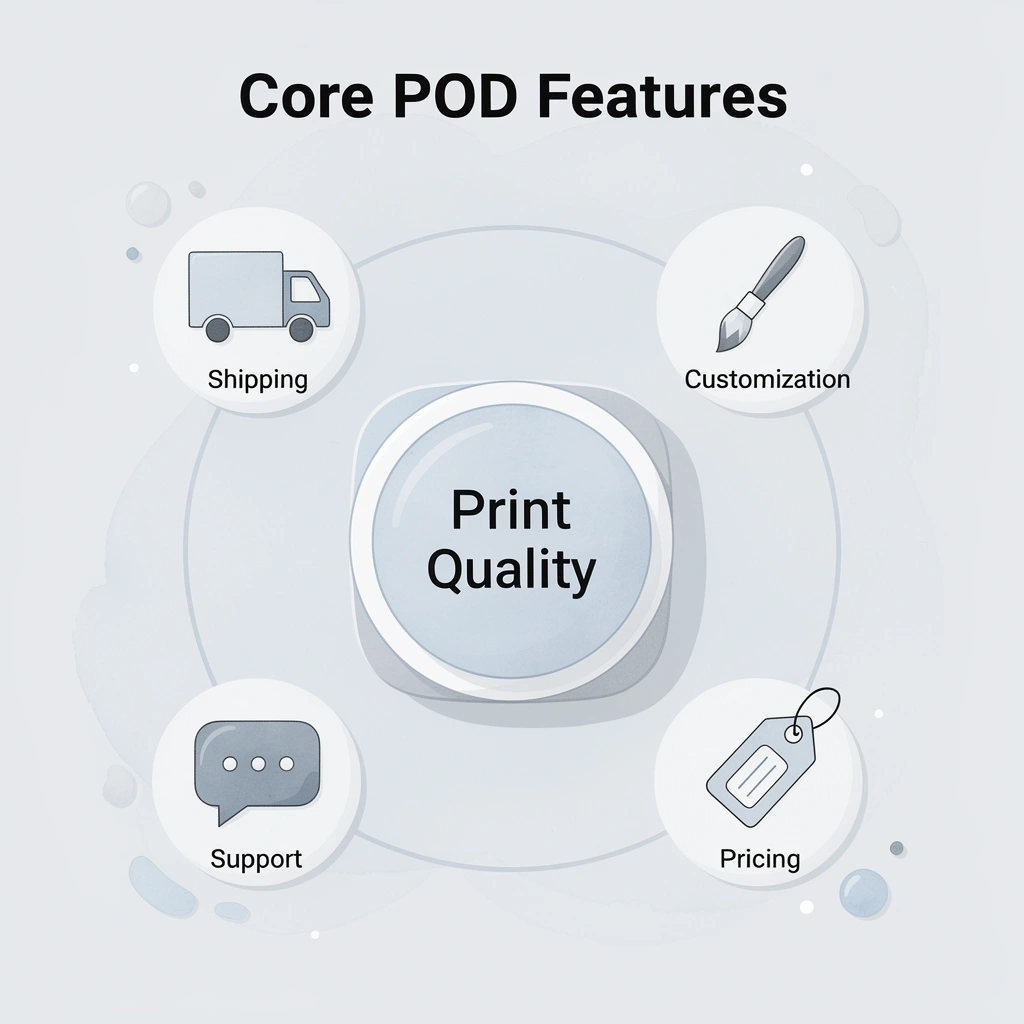
The features you prioritize determine whether you build a sustainable business or constantly troubleshoot quality complaints and fulfillment delays. Print-on-demand platforms vary widely in production standards, shipping networks, customization options, and support responsiveness. Choosing based on only catalog size or lowest base cost ignores the critical mechanics that protect margins and customer satisfaction.
“The features you prioritize determine whether you build a sustainable business or constantly troubleshoot quality complaints and fulfillment delays.” — Core Principle of POD Platform Selection
💡 Tip: Before committing to any platform, evaluate production standards, shipping speed, and support responsiveness — not just the base price.
| Feature | Why It Matters |
|---|---|
| Production Standards | Directly impacts product quality and return rates |
| Shipping Networks | Determines delivery speed and customer satisfaction |
| Customization Options | Expands your product catalog and creative flexibility |
| Support Responsiveness | Protects you when fulfillment issues arise |
⚠️ Warning: Choosing a POD partner based solely on the lowest base cost is one of the most common mistakes new sellers make — it almost always erodes profit margins through hidden fees and customer refunds.
Production Quality and Print Technology
Advanced direct-to-garment equipment and rigorous quality checks ensure your designs arrive bright, detailed, and durable through many washes. Top providers like ooShirts maintain strict color-accuracy standards and inspect products before shipping, catching misprints or fabric flaws that cheaper operations might miss. Coresight Research’s survey of US apparel brands and retailers found that online apparel returns hit 24.4%, significantly higher than the general e-commerce average, with quality and color issues driving much of that loss. Faded graphics or off-center prints trigger returns, and repeat purchases rarely follow. Our quality control standards prevent these costly failures before products ship.
Fulfillment Speed and Geographic Reach
Having multiple production hubs across different regions cuts shipping times and costs. Instead of sending all orders through a single distant facility, you print orders near customers, enabling faster delivery without charging extra for expedited shipping. Customers expect this speed, conditioned by Amazon’s two-day shipping standard. Clear upfront estimates and reliable tracking information build trust, and people accept delays more readily when they know what to expect.
Platform Integration and Automation
Seamless connections with Shopify, Etsy, WooCommerce, and other sales channels eliminate manual order entry and associated errors. Orders flow automatically from purchase to production, inventory syncs in real time, and product updates spread across all storefronts instantly. This frees hours spent on administrative tasks, letting you focus on design iteration and marketing instead of spreadsheet reconciliation.
Why does custom branding matter for Redbubble alternatives?
Custom labels, branded packing slips, and personalized inserts transform shipments into memorable unboxing experiences that reinforce your identity. Your logo on tags and thank-you cards demonstrates a real brand rather than an anonymous fulfillment service. This perceived professionalism justifies higher prices and builds loyalty: generic packaging signals a commodity product, while thoughtful branding signals quality worth returning for.
How do pricing models affect groups ordering through Redbubble alternatives?
Most print-on-demand marketplaces lock you into their ecosystem with limited branding and no volume discounts, which fails when schools, nonprofits, or businesses need matching team apparel at predictable costs. Platforms like cheap custom T-shirts offer transparent all-inclusive pricing with no minimums, letting groups order one shirt or a thousand without artificial pricing tiers or quality compromises.
Related Reading
- Business T-Shirt Design Ideas
- Types of T-shirt Printing
- T-shirt Design Size
- How To Print A Picture On A Shirt
- Best T Shirt Material for Printing
- Best Corporate Apparel Companies
- Best File Type For T-shirt Printing
- Family Reunion T-shirt Ideas
- T-shirt and Ink Color Combinations
- T-shirt Screen Printing Design Ideas
20 Best Redbubble Alternatives for Print on Demand in 2026
If Redbubble no longer matches your goals, you’re not alone. Artists want better profit margins, stronger control over their brand, more predictable policies, and better customer experiences. Buyers want better product quality, faster delivery, and more customization options. Several print-on-demand companies can help with these problems. The key is finding the platform that fits your business model, audience, and growth plans.
“Artists and buyers alike are demanding more — better margins, faster shipping, and greater brand control — pushing creators to explore platforms beyond the obvious choices.” — Print on Demand Industry Insight
💡 Tip: Before switching platforms, clearly define your top three priorities — whether that’s higher royalties, brand customization, or product variety — so you can match the right alternative to your specific needs.
| Priority | What to Look For |
|---|---|
| Profit Margins | Platforms with low base costs and flexible pricing |
| Brand Control | Custom storefronts, white-label packaging, branded inserts |
| Product Quality | Verified print partners, sample ordering options |
| Delivery Speed | Local fulfillment centers, express shipping options |
| Policy Stability | Transparent, consistent seller terms and payout schedules |
🎯 Key Point: The best Redbubble alternative isn’t the most popular one — it’s the one specifically aligned with your business model, your target audience, and your long-term growth plans.

1. ooShirts
ooShirts stands out as a dependable print-on-demand and custom printing service focused on high-quality apparel, especially t-shirts, with flexible options for individuals, teams, and small businesses. It solves Redbubble issues like fading prints and unpredictable shipping by offering durable methods, free standard shipping, guaranteed delivery dates, and no minimums, so you test designs risk-free and scale confidently without inventory waste or quality complaints.
Key Features
- No Minimum Order Quantity — Order just one custom t-shirt or scale to hundreds without restrictions, perfect for testing designs or small needs.
- Low Price Guarantee — If you find a lower price online, ooShirts matches it, ensuring the best value through bulk purchasing and efficient operations.
- Amazing Print Quality — Uses top-notch inks and years of expertise for prints that last wash after wash, with a guarantee to redo orders free of material defects.
- Free Standard Shipping — Included in pricing with guaranteed delivery dates, typically within 7-10 business days, eliminating unexpected costs.
- Expert Design Review — A professional team reviews every order and offers refinements before printing.
- Screen Printing and DTG Options — Choose screen printing for bold, durable results or direct-to-garment for full-color, photo-realistic designs.
- Wide Variety of T-Shirt Styles and Brands — Includes unisex, fitted, athletic, youth, women’s, and premium options like Gildan and Bella+Canvas with many colors.
- Easy Online Design Tool — Upload images, add text with custom fonts/colors, browse clip art library, sleeve printing, real-time pricing, and AI editing options.
- Rush Shipping Available — Expedited delivery in as little as 3-5 business days when needed.
- 7-Day Support — Live chat, phone (888-257-1918), and email assistance from real experts open every day of the week.
Best For
Schools, nonprofits, small businesses, teams, families, and individuals seeking affordable, high-quality custom apparel without inventory risks or platform limitations.
Pros
All-inclusive pricing with free shipping and setup; durable prints and reliable delivery build customer satisfaction; outstanding service and easy tools reduce hassle; strong value through low prices and no minimums.
Cons
Primarily focused on t-shirts and related apparel rather than a full range of home goods or accessories.
Accessibility
Fully online, mobile-friendly design app, instant quoting, live chat, phone support, help center, design retrieval, order tracking, and US-based operations for straightforward access.
2. Printful
Printful delivers premium print-on-demand fulfillment with in-house production facilities that ensure consistent, high-quality across a broad catalog. It directly tackles Redbubble’s quality inconsistencies and limited branding by offering white-label options, custom packaging, and seamless integrations, letting you build a professional brand with reliable global shipping.
Key Features
- In-house DTG, DTF, embroidery, and sublimation printing.
- Over 300 products, including apparel, accessories, and home goods.
- Advanced branding tools like custom labels and packaging inserts.
- Strong integrations with Shopify, Etsy, Amazon, and more.
- Global fulfillment centers for faster delivery.
- Mockup generator and design maker tools.
- Detailed order tracking and analytics.
Pros
Superior consistent print quality builds customer loyalty; extensive customization supports strong branding; reliable integrations streamline operations.
Cons
Higher base costs compared to some network providers.
Accessibility
User-friendly dashboard, mobile app support, and excellent documentation for sellers worldwide.
3. Printify
Printify connects you to a vast network of printing partners for competitive pricing and massive product variety. It addresses Redbubble’s high platform fees and shipping issues by offering lower production costs, multiple supplier options, and tools to optimize fulfillment, reducing delays and boosting profits.
Key Features
- Access to hundreds of products across many suppliers.
- Competitive base pricing with Premium plan discounts.
- Automatic order routing to the best suppliers.
- Integrations with major e-commerce platforms.
- Design tool and mockup generator.
- Detailed analytics and performance tracking.
- Options for custom branding and packaging.
Pros
Lower costs improve margins significantly; a huge catalog allows broad product lines; flexibility in supplier selection optimizes speed and quality.
Cons
Quality can vary slightly between printers if not monitored.
Accessibility
Intuitive web platform with easy setup and support resources available globally.
4. Gelato
Gelato emphasizes localized production across numerous countries to enable fast shipping and support sustainability. It counters Redbubble’s delivery delays and international shipping costs with nearby fulfillment that reduces transit times, customs issues, and carbon footprint while maintaining strong print quality.
Key Features
- Local printing in over 30 countries.
- A wide range of wall art, apparel, and home decor.
- Sustainable materials and practices.
- Seamless e-commerce integrations.
- High-quality digital and specialty printing.
- Custom branding options.
- Fast local delivery timelines.
Pros
Quick worldwide shipping delights customers; localized production cuts costs and delays; eco-friendly focus appeals to conscious buyers.
Cons
Some premium products carry higher pricing.
Accessibility
Clean interface with global seller support and easy integration tools.
5. Zazzle
Zazzle functions as a creative marketplace with strong customization tools similar to Redbubble but with better personalization options. It helps overcome design theft and limited control by providing robust tools for unique products and direct sales, while supporting artists’ earnings.
Key Features
- Extensive personalization for gifts and apparel.
- Large catalog of customizable items.
- Marketplace exposure for designs.
- Design tools with templates and uploads.
- Options for paper goods, clothing, and accessories.
- Royalty settings for creators.
- Integration capabilities for external sales.
Pros
Strong customization drives unique sales; marketplace traffic boosts visibility; flexible creator tools.
Cons
The marketplace model still limits full brand ownership.
Accessibility
Straightforward creator dashboard and consumer-friendly browsing.
6. Society6
Society6 operates as a vibrant artist-focused marketplace that emphasizes high-quality home decor and apparel, offering creators higher royalty rates and better visibility controls than Redbubble. It tackles oversaturation and design theft through curated collections and dedicated artist support, while delivering premium printing that resists fading and delivers consistent results buyers trust. Sellers gain more sustainable earnings and reduced platform dependency issues.
Key Features
- High-quality giclée printing for wall art and canvases.
- Wide selection of home goods, apparel, and accessories.
- Artist-centric royalty structure with transparent payouts.
- Curated marketplace exposure for original designs.
- Strong focus on aesthetic and decorative products.
- Tools for portfolio management and promotion.
- Reliable global shipping with quality guarantees.
Pros
Superior print durability builds customer loyalty and repeat purchases; higher artist margins solve fee erosion; a curated environment reduces unfair competition from low-effort copies.
Cons
The marketplace model still shares some control with the platform.
Accessibility
Easy artist dashboard, mobile-friendly upload tools, and responsive support for global creators.
7. Spring (formerly Teespring)
Spring empowers content creators and influencers with integrated storefronts and social selling tools that connect directly to audiences. It addresses Redbubble’s branding limitations and low earnings by offering custom storefronts, improved profit control, and campaign features that drive targeted traffic and higher conversion rates, all without heavy platform fees.
Key Features
- Custom-branded storefront builder.
- Social media and video platform integrations.
- Flexible pricing and profit margin controls.
- Campaign management for launches and promotions.
- Diverse apparel and merch catalog.
- Analytics for audience engagement tracking.
- Fast fulfillment through reliable partners.
Pros
Direct customer relationships and data ownership; higher earnings potential through controlled pricing; seamless creator workflow reduces operational burnout.
Cons
Best suited for creators with existing audiences.
Accessibility
Intuitive creator tools, mobile app support, and straightforward setup for non-technical users.
8. TeePublic
TeePublic provides a straightforward marketplace focused on apparel with artist-friendly tools and steady traffic. It counters Redbubble’s quality complaints and shipping unpredictability with consistent printing standards, competitive royalties, and efficient fulfillment that gets durable products to customers faster.
Key Features
- Strong emphasis on t-shirts and apparel.
- Simple upload and tagging system for visibility.
- Tiered royalty options for creators.
- Niche community and trending discovery.
- Reliable print quality on premium blanks.
- Global shipping network.
- Easy integration with external sales channels.
Pros
Quick approval and listing process speeds up sales; solid margins compared to high-fee platforms; focused catalog reduces buyer confusion and returns.
Cons
Less emphasis on non-apparel products.
Accessibility
Clean, simple interface with helpful creator resources and community support.
9. Amazon Merch on Demand
Amazon Merch on Demand leverages Amazon’s massive customer base and logistics for apparel-focused print-on-demand. It solves Redbubble’s visibility and shipping delays with prime-level fulfillment, trusted delivery, and built-in traffic that boosts sales volume while maintaining strict quality standards.
Key Features
- Access to Amazon’s vast shopper audience.
- Premium apparel printing on quality blanks.
- Fast Prime shipping options.
- Strict quality approval process.
- Tiered invitation system based on performance.
- Detailed sales reporting and analytics.
- Automatic handling of orders and returns.
Pros
Enormous built-in traffic eliminates marketing struggles; reliable high-volume fulfillment; strong brand trust reduces customer hesitation.
Cons
The approval process can be competitive and selective.
Accessibility
Seller dashboard integrated with Amazon tools, with resources for approved creators.
10. Spreadshirt
Spreadshirt offers a flexible mix of marketplace and custom shop options with strong European roots and global reach. It fixes Redbubble’s international shipping costs and branding gaps through localized production, custom shop domains, and detailed product customization that supports premium, durable merch.
Key Features
- Localized printing in multiple regions.
- Custom shop creation with your branding.
- Wide apparel and accessory selection.
- Advanced design editor tools.
- Flexible royalty and pricing settings.
- High-quality screen and digital printing.
- Comprehensive order management system.
Pros
Better control over storefront and customer experience; regional production cuts shipping times and costs; strong customization for unique brand identity.
Cons
Marketplace competition remains on the main site.
Accessibility
User-friendly tools for both beginners and experienced sellers, with multilingual support.
11. CustomCat
CustomCat specializes in fast US-based production with competitive pricing on apparel and accessories. It directly resolves Redbubble’s shipping delays and quality variability through domestic fulfillment centers, strict quality inspections, and reliable turnaround times, delivering durable products to customers quickly and consistently.
Key Features
- Rapid US production and fulfillment.
- Competitive wholesale pricing on premium blanks.
- Embroidery options alongside DTG and screen printing.
- Wide apparel and accessory catalog.
- Easy integrations with major e-commerce platforms.
- Bulk order discounts and no minimums for testing.
- Detailed product quality guarantees.
Pros
Faster domestic shipping reduces delays and costs; strong quality controls minimize returns; better margins through competitive pricing.
Cons
A stronger focus on the US market may affect international shipping times.
Accessibility
Straightforward dashboard with robust support and integration guides for all seller levels.
12. Gooten
Gooten provides an automated print-on-demand network with extensive options for home goods and apparel. It tackles branding limitations and inconsistent quality through white-label fulfillment, automated order routing, and vetted partners, ensuring premium results and full control over customization.
Key Features
- Automated order processing and routing.
- Large selection of home decor and apparel.
- White-label and custom branding tools.
- API integrations for seamless workflows.
- Global partner network for optimized fulfillment.
- Product sampling and quality testing options.
- Analytics and performance insights.
Pros
Full automation saves time and reduces errors; strong branding capabilities build customer loyalty; reliable partners address quality complaints.
Cons
Learning curve for full API utilization.
Accessibility
Developer-friendly platform with clear documentation and responsive support.
13. Fourthwall
Fourthwall delivers an all-in-one solution tailored for creators with professional storefronts and high-quality merch. It overcomes Redbubble’s low earnings and limited branding by offering custom storefronts, direct fan engagement tools, and premium production that supports higher pricing and stronger artist margins.
Key Features
- Custom-branded storefront builder.
- High-quality printing on premium materials.
- Fan membership and subscription tools.
- Social and content platform integrations.
- Detailed analytics for creator insights.
- Flexible pricing and profit controls.
- Reliable fulfillment and shipping.
Pros
Direct audience ownership and higher margins; professional branding elevates perceived value; tools for ongoing fan engagement.
Cons
Optimized for creators with established followings.
Accessibility
Intuitive creator-focused interface with excellent onboarding resources.
14. Displate
Displate focuses on premium metal prints and wall art with exceptional quality and durability. It addresses design theft concerns and fading quality issues through unique metal printing technology, strong artist protections, and collectible products that stand the test of time and command higher prices.
Key Features
- Premium magnetic metal print technology.
- Scratch-resistant and vibrant, long-lasting prints.
- A wide range of sizes and framing options.
- Artist royalty program with fair shares.
- Secure marketplace for original designs.
- Eco-friendly production processes.
- Global shipping with tracking.
Pros
Superior durability eliminates fading complaints; unique product format reduces direct competition; higher value per sale boosts earnings.
Cons
Specialized in wall art rather than a full apparel range.
Accessibility
Easy upload tools and artist dashboard with community features.
15. Threadless
Threadless combines a creative community marketplace with strong artist voting and a focus on quality. It counters oversaturation with a curated approach and community-driven visibility, rewarding original designs while delivering consistently high-quality prints that satisfy customers.
Key Features
- Artist community and design voting system.
- Quality apparel and product printing.
- Fair artist royalty structure.
- Marketplace with strong organic traffic.
- Design challenges and promotional opportunities.
- Reliable fulfillment network.
- Tools for portfolio and sales tracking.
Pros
Community validation boosts visibility for quality work; consistent prints build trust; a collaborative environment supports creators.
Cons
A competitive environment requires strong community participation.
Accessibility
Engaging platform with helpful resources for artists of all experience levels.
16. CafePress
CafePress is a long-standing marketplace for custom products, offering a broad catalog, easy upload tools, and community-driven discovery. It tackles Redbubble’s oversaturation and design theft through established moderation practices and a focus on unique, personalized items, while offering reliable production that delivers durable goods and better control over your creative catalog.
Key Features
- Extensive product range including apparel, home goods, and accessories.
- Simple design upload and customization tools.
- Marketplace traffic for organic exposure.
- Royalty-based earnings for creators.
- Options for custom shops and storefronts.
- Print-on-demand with no inventory requirements.
- Global shipping and order fulfillment.
Pros
Familiar marketplace model eases the transition from Redbubble; strong personalization drives unique sales; consistent quality reduces fading and return issues.
Cons
Marketplace competition and shared branding elements persist.
Accessibility
Straightforward web interface with creator resources and customer support for all experience levels.
17. Bonfire
Bonfire specializes in creator-focused campaigns and fundraisers with integrated storefronts and social sharing tools. It addresses low artist earnings and branding limitations by letting you set higher margins, build direct connections with fans, and run targeted campaigns that drive traffic without heavy platform cuts or delays.
Key Features
- Custom campaign and storefront creation.
- Social media integration for easy promotion.
- Flexible pricing and profit settings.
- High-quality apparel and merch production.
- Fundraising and limited-time drop tools.
- Analytics for campaign performance.
- Reliable fulfillment and customer service.
Pros
Higher profit control solves fee erosion; direct audience building overcomes ownership issues; fast campaign launches reduce shipping frustration.
Cons
Best for creators with engaged communities or fundraising goals.
Accessibility
User-friendly tools designed for non-technical creators with excellent mobile support.
18. PrintAura
PrintAura delivers US-based print-on-demand services with a focus on premium apparel and fast turnaround. It counters quality inconsistencies and shipping delays through domestic production, strict quality checks, and competitive pricing, ensuring durable, vibrant products arrive quickly while supporting strong margins.
Key Features
- Fast US production and fulfillment.
- Premium blanks and printing techniques.
- No minimum order requirements.
- White-label and branding options.
- Integrations with major e-commerce platforms.
- Mockup generator and design tools.
- Reliable quality guarantees.
Pros
Domestic shipping cuts delays and costs; superior print durability builds trust; better margins than high-fee marketplaces.
Cons
Primarily, US-focused fulfillment may impact international orders.
Accessibility
Clean dashboard with responsive support and easy navigation for beginners and pros.
19. Merchize
Merchize offers a comprehensive print-on-demand network with competitive pricing and global reach. It solves inconsistent quality, high fees, and branding gaps through vetted suppliers, automation tools, and white-label services, allowing you to maintain full control and deliver reliable, high-value products.
Key Features
- Vast supplier network for diverse products.
- Automated order routing and processing.
- Competitive base costs and discounts.
- Custom branding and packaging.
- Seamless platform integrations.
- Analytics and performance tracking.
- Quality assurance across partners.
Pros
Lower costs improve profitability; flexible options address quality variability; full branding control strengthens customer relationships.
Cons
Quality requires active supplier selection.
Accessibility
Intuitive platform with global support and comprehensive guides.
20. Prodigi
Prodigi provides a global print-on-demand network that emphasizes fine art and high-quality wall decor, as well as apparel. It tackles delivery delays and design visibility issues with localized production in multiple regions, premium printing standards, and tools that protect original work while ensuring fast, sustainable fulfillment.
Key Features
- Localized printing across many countries.
- Premium giclée and specialty printing.
- Wide range of wall art and merch.
- Artist protection and licensing tools.
- E-commerce integrations.
- Sustainable production practices.
- Detailed order tracking and support.
Pros
Regional fulfillment reduces shipping times and costs; exceptional print quality eliminates durability complaints; strong IP tools fight theft.
Cons
A specialized focus may limit basic apparel options.
Accessibility
Professional dashboard with resources for artists and sellers worldwide.
How to Choose the Right Redbubble Alternative for Your Needs
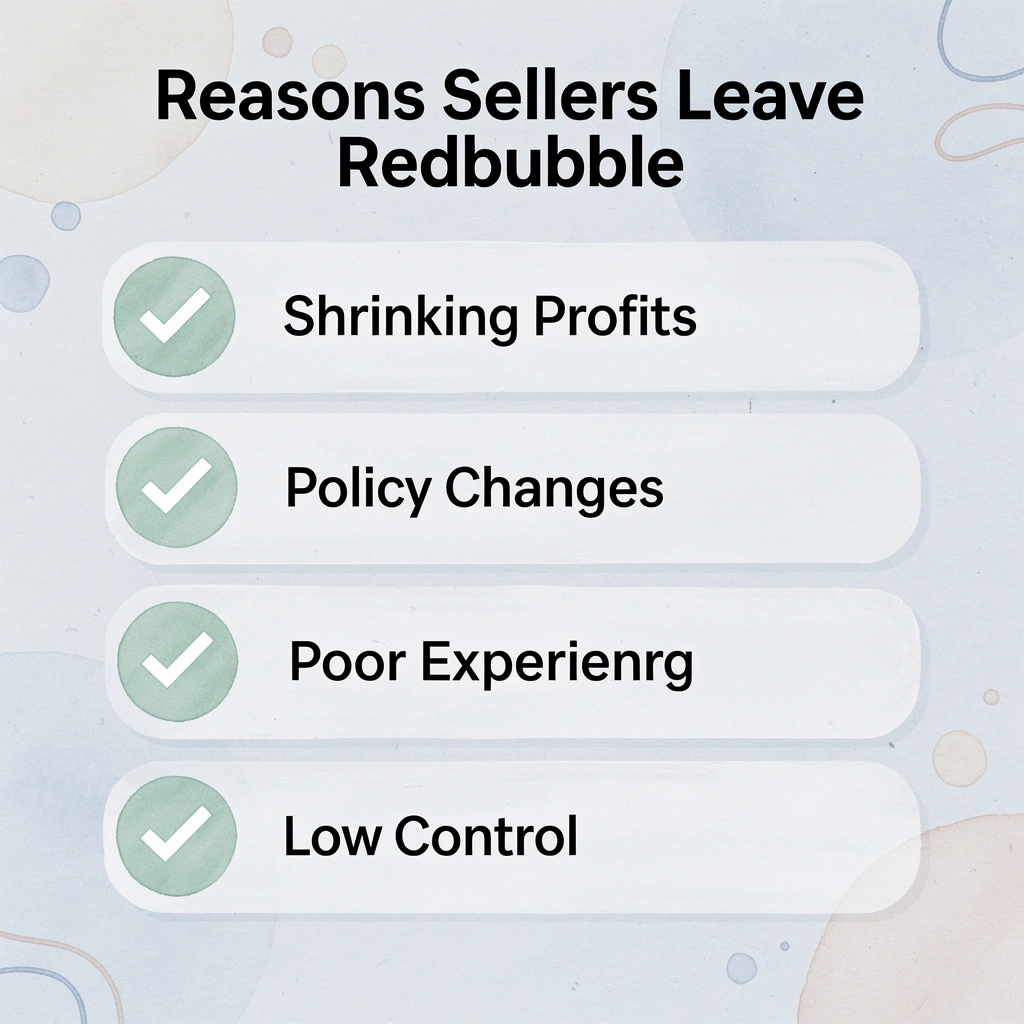
Choosing a Redbubble alternative means finding the platform that actually solves your specific problems. If you’re leaving because of shrinking profits, inconsistent policies, limited brand control, or customer experience concerns, switching to another platform with the same weaknesses won’t help. The right choice lines up with your goals, audience, and long-term vision.
“The best platform isn’t the most popular one — it’s the one built for your specific goals, audience, and growth stage.” — Print-on-Demand Industry Insight
| Your Pain Point | What to Prioritize |
|---|---|
| Shrinking profits | Higher royalty rates & pricing control |
| Inconsistent policies | Platform stability & seller protections |
| Limited brand control | Custom storefronts & white-label options |
| Customer experience | Fulfillment quality & support reputation |
🎯 Key Point: Don’t just escape Redbubble — move toward a platform that directly addresses the weaknesses that pushed you to leave in the first place.
⚠️ Warning: Choosing a new platform based on name recognition alone is one of the most common mistakes sellers make. A platform that’s popular isn’t automatically a platform that’s right for you — always evaluate it against your specific goals and long-term vision.
Define Your Business Goals and Model First
Determine whether you need a marketplace for built-in traffic or a fulfillment partner for your own store. Artists seeking passive income benefit from marketplaces’ audience, while brand builders prioritize controlling prices and owning customer data. Marketplaces simplify product uploads but cap growth potential, whereas fulfillment solutions scale with your marketing efforts.
Evaluate Product Catalog and Niche Fit
Look at what items the platform offers and compare them to your target audience and design style. If you sell clothes, you need high-quality blank items and a diverse range of styles to choose from. If you create home decor, you need options like wall art, pillows, and customization features. When your catalog aligns with customer demand, you drive more sales and improve customer satisfaction.
Assess Pricing, Margins, and Fees
Compare base costs, shipping rates, platform fees, and profit potential at realistic retail prices. Transparent structures with low or no minimums protect margins better than high-fee marketplaces. Calculate full order economics, including returns and international shipping, to ensure long-term viability.
Prioritize Print Quality and Durability
Order samples from shortlisted options to test material feel, color accuracy, and wash performance. Consistent, vibrant results build customer trust and reduce returns by addressing common complaints about fading or misprints. Reliable production standards protect your reputation and encourage repeat purchases.
Check Shipping Speed and Global Reach
Check your fulfillment locations, average delivery times, and international options. Local production networks reduce shipping delays and costs while avoiding customs problems. Fast, reliable shipping meets buyer expectations, lowers cart abandonment, and expands your customer reach.
Review Branding and Customization Tools
Look for white-label services, custom packaging, labels, and inserts that create a smooth brand experience. Full control over the unboxing moment increases customer loyalty and perceived brand value. This helps independent sellers stand out and build direct relationships instead of relying on platforms.
Examine Integrations and Ease of Use
Make sure your sales channels, such as Shopify, Etsy, or WooCommerce, work together smoothly. User-friendly dashboards, automation, and mockup tools save time and reduce errors. Strong technical support and reliable order management let you focus on design and marketing.
Consider Support, Analytics, and Scalability
Look at customer service, analytics, and scalability. Responsive support teams solve problems quickly, while detailed analytics guide inventory and marketing decisions. Platforms built for scaling handle rising order volumes without service degradation.
Why ooShirts Is a Smart Alternative to Redbubble
If Redbubble no longer fits your goals, you need a solution to the specific problems that pushed you away: shrinking earnings, limited control, unpredictable policies, and customer experiences that directly affect your reputation. ooShirts addresses these pain points head-on.
“Creators deserve a platform that offers transparent pricing, real control, and consistent policies — not one that quietly erodes their earnings and brand.” — ooShirts Value Proposition
| Problem with Redbubble | How OOShirts Addresses It |
|---|---|
| Shrinking earnings | Higher margin control for sellers |
| Limited control | Customizable pricing and product options |
| Unpredictable policies | Transparent, stable platform rules |
| Poor customer experience | Reliable fulfillment protecting your reputation |
💡 Tip: If any of these four pain points sound familiar, switching to ooShirts could immediately improve both your bottom line and your brand reputation.
🎯 Key Point: ooShirts isn’t just an alternative — it’s a direct response to the most common frustrations creators face on Redbubble, making it a smart, strategic upgrade for serious sellers.
Direct Control Without Marketplace Fees
Redbubble charges fees and markups that reduce your earnings per sale. ooShirts eliminates platform fees entirely. You can order custom t-shirts at low prices directly from us and set your own retail prices, keeping all the profit, whether you’re selling one shirt or ordering in bulk.
Consistent, Durable Print Quality
Redbubble buyers often receive faded or poorly printed items. ooShirts solves this problem with years of experience, high-quality inks, and a guarantee: prints last through numerous washes, or we remake your order at no cost. Customers appreciate bright, long-lasting designs that encourage repeat purchases and positive reviews.
Predictable Shipping and No Hidden Costs
Redbubble’s multi-supplier model creates high shipping fees and delays. ooShirts includes free standard shipping at every price point with guaranteed delivery dates and rush options. Production facilities on both US coasts ensure fast, reliable turnaround and on-time delivery, reducing cart abandonment while keeping total costs transparent and low.
No Minimums for Flexible Ordering
Marketplaces like Redbubble force volume commitments or limit testing. According to mydesigns.io, ooShirts offers no minimum order quantity for DTG printing, allowing you to test designs without risk and place small custom orders. This flexibility helps individuals, teams, schools, and small businesses grow without the risk of inventory or the pressure to buy in bulk upfront.
Expert Design Support and Review
Redbubble provides minimal oversight, leading to print issues. ooShirts assigns professionals to review every design before production. We offer refinements and proofs to ensure the best results, prevent errors, improve the final product’s appearance, and deliver exactly what you imagined.
The question is whether you’re ready to take back control of your brand and profits.
Related Reading
- Printify Alternatives
- Rush Order Tees Vs Custom Ink
- Zazzle Alternatives
- Vistaprint Vs Custom Ink
- 4imprint Competitors
- Vistaprint Alternatives
- Redbubble Alternatives
- Bonfire Competitors
- 4imprint Vs Vistaprint
Start Designing Your Custom Shirts Today
Marketplace limitations, inconsistent quality, unpredictable costs, and restricted control plague every alternative. Staying with familiar solutions means permanently accepting these frustrations. The longer you work around platform restrictions instead of choosing a solution built for your needs, the more time and money you spend compensating for unnecessary gaps.
“The longer you work around platform restrictions instead of choosing a solution built for your needs, the more time and money you spend making up for gaps that shouldn’t exist.” — ooShirts, 2026
⚠️ Warning: Every workaround you accept today becomes a permanent cost tomorrow: wasted time, lost budget, and creative compromises you never needed to make.
That’s exactly why cheap custom T-shirts stand out in 2026. Our transparent instant pricing, flexible order quantities starting at one shirt, multiple printing options, and easy-to-use Design Lab let you upload artwork, add text, select colors, and preview designs in real time. Whether you’re ordering for your business, school, nonprofit, fundraiser, event, team, or community, you control what you create, how you order, and who receives your products. No marketplace competition, no subscription fees, no complicated setup standing between you and finished custom apparel.
| Feature | ooShirts | Typical Alternatives |
|---|---|---|
| Instant Pricing | ✅ Transparent & upfront | ❌ Hidden fees common |
| Minimum Order | ✅ Starting at 1 shirt | ❌ Often 12–24 minimum |
| Design Preview | ✅ Real-time Design Lab | ❌ Limited or unavailable |
| Subscription Required | ✅ None | ❌ Often required |
| Printing Options | ✅ Multiple methods | ❌ Restricted choices |
💡 Tip: No minimum order means you can test a design with a single shirt before committing to a larger run — zero risk, maximum flexibility.
Visit ooShirts, choose the apparel you want to customize, and use the Design Lab to watch your design come together in real time. You’ll receive an instant quote before committing to anything. Larger quantities bring lower per-unit pricing that stretches your budget further than expected. You need no design experience, technical skills, or minimum order to get started: just your idea.
✅ Best Practice: Start with your instant quote to see how larger order quantities reduce your per-unit cost, then scale your order to match your budget.
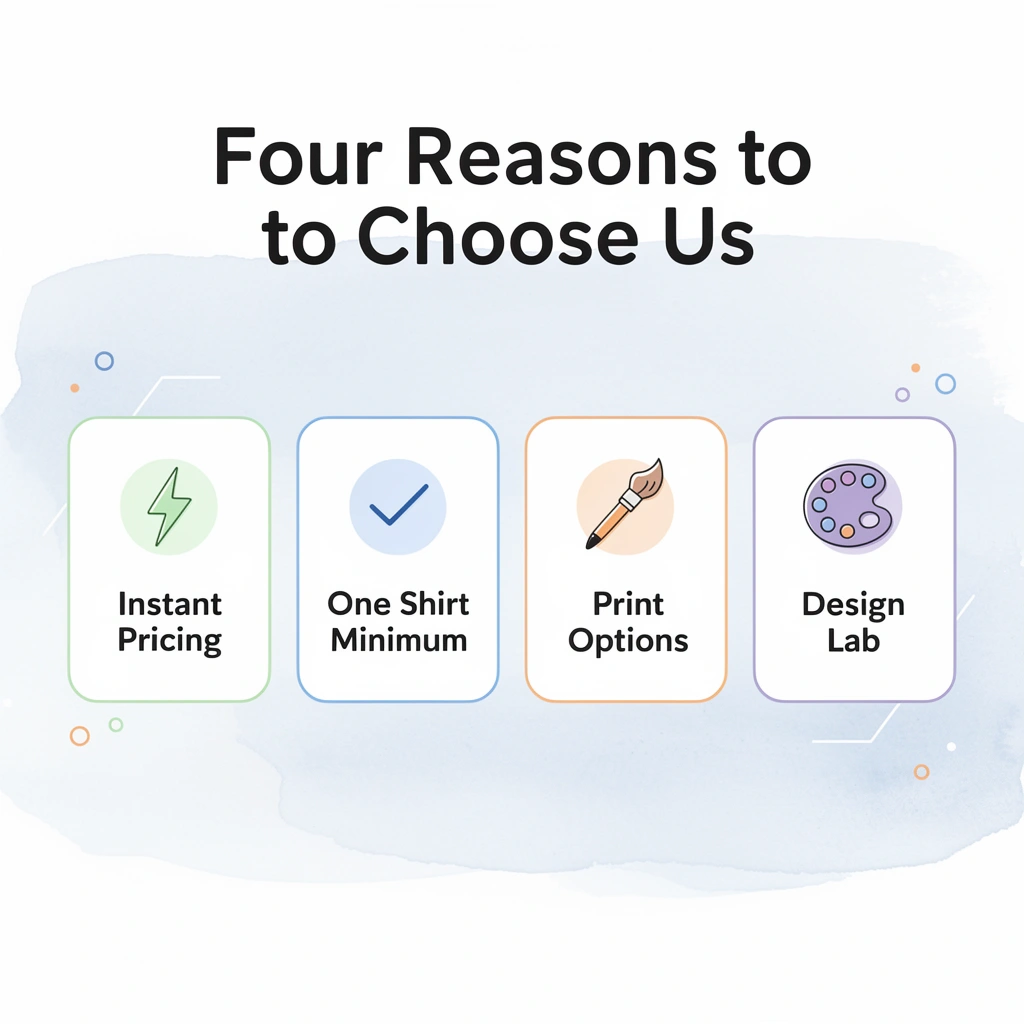
Head over to ooShirts today, explore the Design Lab, and get your instant quote. There’s no guesswork around pricing, no subscription required, and no frustrating limitations between you and the custom apparel you need. Every detail—from design to delivery—is built around giving you complete control.
🎯 Key Point: ooShirts combines instant pricing, no minimums, and a real-time Design Lab into one seamless experience, making it the smartest choice for custom apparel in 2026 and beyond.
Leave a Reply