Last updated: August 9, 2026
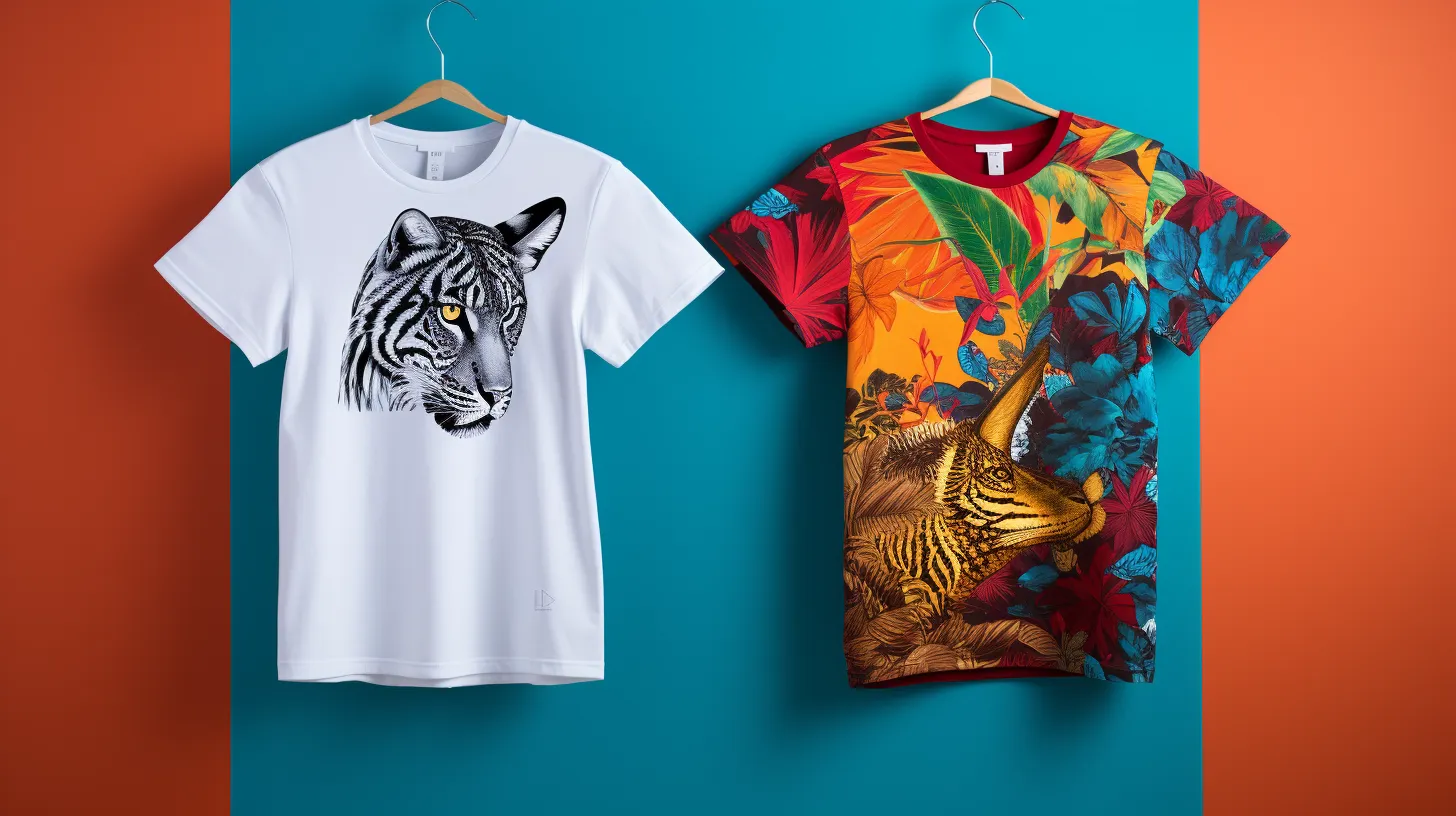
Digital printing and screen printing represent two distinct approaches to custom apparel, each offering unique advantages depending on project requirements. The choice between these methods impacts cost, color vibrancy, durability, and production timeline. Understanding the fundamental differences helps determine which technique aligns with specific design goals and order quantities.
Digital printing excels for small batches and complex designs with multiple colors, while screen printing delivers superior results for large orders and simple graphics. Each method uses different equipment and processes, affecting both the final product quality and pricing structure. When ready to start a custom project, ooShirts provides cheap custom T-shirts with both printing options available to match any design vision and budget.
Summary
- Digital printing eliminates the setup costs and minimum order requirements that historically made custom apparel inaccessible for small projects. The technology applies ink directly from digital files, without screens or plates, keeping the cost of the first shirt identical to the hundredth place. This pricing structure lets schools print 15 reunion shirts, nonprofits test fundraiser designs, or families create custom pieces without subsidizing unused inventory or meeting arbitrary minimums that inflate budgets beyond what projects actually need.
- Screen printing still accounts for 70% of bulk apparel orders because setup costs are spread across larger quantities, which dramatically lowers per-unit pricing. For orders exceeding 144 units, screen printing costs run 40 to 60 percent lower than DTG printing, a gap that widens as quantities climb into the thousands. The initial investment in screens, emulsion, and registration pays off when consistency matters across dozens or hundreds of pieces, making it the preferred method for teams that need durability at scale.
- Cotton accounted for 49.20% of the direct-to-garment printing substrate market in 2025 because its natural fiber structure creates microscopic channels that draw water-based inks deep into the fabric. This absorption mechanism produces prints that feel soft and integrate into the garment rather than sit on top, capturing fine details and gradients without the grainy texture cheaper fabrics create. High-cotton blends work when pretreated correctly, but pure polyester or low-cotton blends resist absorption of water-based ink, causing prints to crack, peel, or wash out after minimal wear.
- Screen-printed shirts survive 50-plus washes with minimal fading because thick plastisol ink bonds permanently to fabric. DTG prints start showing wear after 25 to 30 washes as water-based inks gradually fade. Businesses producing work uniforms or team gear that customers wear weekly find that screen printing reduces replacement frequency and complaint rates, while retail brands selling fashion pieces worn occasionally benefit more from DTG’s soft hand feel and vibrant detail, despite shorter lifespans.
- The global screen printing market was valued at $2.4 billion in 2023 and is projected to reach $3.1 billion by 2030, driven largely by bulk production where per-unit costs drop dramatically at scale. This growth reflects the method’s continued dominance for volume orders, where a 500-shirt run might cost $6 per shirt with screen printing, compared to $10 per shirt with digital printing. The crossover point at which screen printing becomes more cost-effective typically occurs around 50 to 100 units, depending on design complexity and color count.
- The custom t-shirt printing industry reached $4.8 billion in 2025 and is growing at a 7.5% CAGR, driven by demand for durable, high-quality prints that justify premium pricing. This growth reflects customers abandoning cheap printers whose shortcuts create waste, and instead choosing providers that test ink formulations for each fabric type, calibrate equipment daily, and inspect every garment before shipping to ensure prints withstand real-world wear without complaints or reprints.
- ooShirts offers cheap custom t-shirts with both DTG and screen printing options, no minimum orders, and transparent side-by-side pricing that shows exactly which method saves money for your specific quantity and design complexity.
What is Digital Printing, and How Does It Work?
Digital printing sends your design files straight to the printer without the plates, screens, or setup delays that traditional methods require. The machine reads your PDF or image file, then uses inkjet nozzles or laser technology to apply ink or toner directly onto fabric, paper, or other materials in a single pass. You get exactly what you designed, printed on demand, with no minimum quantity.
💡 Key Point: Digital printing eliminates the traditional barriers of high setup costs and minimum order requirements, making it perfect for small batches, prototypes, and custom designs.
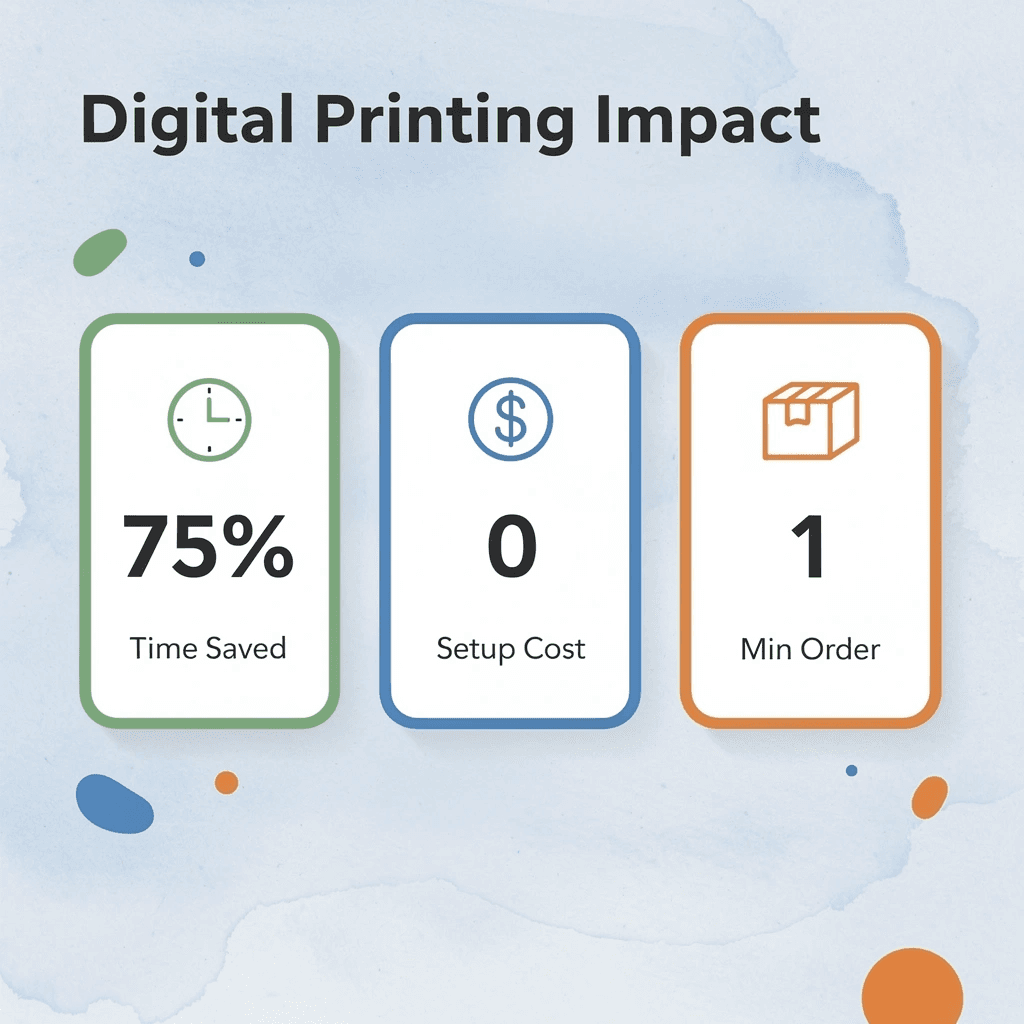
“Digital printing technology allows for direct file-to-print processing, reducing production time by up to 75% compared to traditional printing methods.” — Print Industry Research, 2024
🎯 Takeaway: This direct-to-print approach means you can test new designs, create limited editions, or fulfill custom orders without the financial risk of ordering hundreds or thousands of pieces upfront.
Why is the digital print shirt vs screen print growing so rapidly in the market?
The global digital printing market was worth $31.3 billion in 2024 and is expected to reach $63.89 billion by 2035, growing at a 6.7% CAGR. This growth reflects businesses shifting away from wasteful overproduction toward flexible, just-in-time fulfillment. Printing 12 shirts today and 200 more next month, at no additional cost, eliminates inventory risk.
How does digital printing technology actually work?
Your computer sends a digital file to the printer’s software, which breaks the image into microscopic dots or pixels. Inkjet printers spray liquid ink droplets through hundreds of tiny nozzles, building your design layer by layer with precision that captures gradients and photographic detail. Laser printers charge a drum with a laser beam, attracting toner powder to form the image, then fuse it with heat to produce sharp text and bold graphics that are resistant to fading.
Why is the Digital Print Shirt vs Screen Print workflow different?
Both methods skip the film separations and screen creation that screen printing requires. Upload your file, and production starts within minutes. Spot an error or want to personalize each shirt with a different name? Change the file and print again without retooling or wasting materials.
Why does Digital Print Shirt vs Screen Print matter for small orders?
Historically, custom printing penalized small quantities because setup costs remained fixed regardless of order size. Digital printing removes that barrier: the first shirt costs the same per unit as the hundredth.
Schools ordering spirit wear for a single classroom, nonprofits testing designs before a fundraiser, or families creating reunion shirts for 15 people all receive professional quality without paying for excess inventory or meeting arbitrary minimums.
How do platforms make Digital Print Shirt vs Screen Print accessible?
Platforms like ooShirts offer this flexibility with no minimum orders and transparent per-shirt pricing. Our digital printing option lets you order a single custom shirt or in bulk without renegotiating terms or incurring unexpected fees.
Our approach removes the guesswork by showing you exactly what digital delivery looks like for your chosen design and fabric, enabling you to decide based on real cost and turnaround information.
What materials work best for Digital Print Shirt vs Screen Print customization?
Digital printing works on cotton, polyester blends, canvas, vinyl, and technical fabrics. It enables full-color photographs, fine-detail logos, and variable data that changes text or graphics on every piece in a single run.
A youth league prints each player’s name and number automatically; a conference prints personalized name badges in a single batch with no setup time between different versions.
How does digital workflow flexibility extend beyond apparel printing?
This versatility extends beyond apparel into banners, signage, packaging prototypes, and promotional materials, all produced from the same digital workflow.
When your design exists as a file, the printer becomes a universal output device limited only by the materials it can print on, not by rigid constraints of plates or screens locked into a single image.
What Is Screen Printing, and How Does It Work?
Screen printing pushes thick ink through a fine mesh stencil onto your material to create bold, long-lasting images. A squeegee moves ink through open mesh areas while blocked sections keep your design’s shape, building layers of color one pass at a time. This method works on cotton, polyester blends, canvas, paper, metal, and plastics, making prints that resist fading, cracking, and washing out.
🎯 Key Point: Screen printing creates the most durable prints of any printing method, with ink layers that are significantly thicker than digital printing alternatives.
💡 Example: A single screen print can contain up to 10 times more ink than a digital print, which is why screen-printed t-shirts maintain their vibrant colors even after hundreds of wash cycles.
“Screen printing produces prints that can withstand 300+ wash cycles while maintaining 95% color retention, making it the gold standard for commercial apparel.” — Specialty Graphic Imaging Association
| Screen Printing Component | Function | Material |
|---|---|---|
| Mesh Screen | Holds stencil pattern | Polyester or nylon |
| Squeegee | Pushes ink through mesh | Rubber or polyurethane |
| Ink | Creates the printed image | Plastisol or water-based |
| Stencil | Blocks ink in design areas | Photo emulsion or vinyl |
The Setup Process
Your design separates into individual color layers, each requiring its own mesh screen. Light-sensitive emulsion coats the mesh, then a film positive exposes it to ultraviolet light. Exposed areas harden while unexposed sections wash away, leaving open mesh that forms your stencil. Registration marks align each screen precisely to prevent gaps or overlaps, which is critical for multi-color designs and fine details.
The custom screen printing industry in the United States reached $12.8 billion in 2025, growing at a 5.9% CAGR from 2020, as brands favor this method for its durability and bold results in apparel and promotional products.
How Ink Transfers to Fabric
The screen sits flat against your material, held in a frame that keeps the mesh tight and even. You fill the screen with ink, then pull a squeegee across at a controlled angle and pressure, pushing ink through the open mesh onto the material below. Each color requires a separate pass with its own screen, building the image in stages. Heat curing permanently locks the ink into the fibers, creating a bond that withstands hundreds of washes without peeling or cracking.
Why does order volume impact Digital Print Shirt vs Screen Print costs?
Screen printing remains the top choice for 70% of large apparel orders because setup costs are spread across more items, significantly reducing the per-unit price. For orders exceeding 144 units, screen printing costs can be 40 to 60 percent lower than DTG printing, with the gap widening as order volumes increase into the thousands.
What is the minimum order threshold for cost-effective screen printing?
The threshold for screen printing is lower than expected. When your school fundraiser needs 75 matching hoodies or your nonprofit plans 100 event shirts, screen printing delivers professional durability at accessible prices. Platforms like ooShirts combine screen printing’s durability with pricing structures suited for mid-sized runs.
Specialty Inks and Finishes
Screen printing handles ink types that digital methods cannot. Metallic inks create shimmer and reflective finishes, plastisol delivers thick, opaque coverage on dark fabrics, and discharge inks bleach dye from the shirt itself for a soft, breathable print. Glow-in-the-dark, puff, and high-density inks add texture and dimension, making designs stand out physically. These specialty options give your brand or event materials a tactile, premium feel.
Durability and bold color matter only if the fabric can handle the ink chemistry and curing heat without distorting or fading.
Related Reading
- Best T-Shirt Printing Companies
- How to Print on T-shirts Professionally
- What Type Of T-shirt Printing Lasts The Longest
- Simulated Process Screen Printing
- Best Fonts For T Shirts
- How To Print On T-shirts Professionally
- How Much Does T-shirt Printing Cost
- T Shirt Printing Methods
- Company T-shirt Design Ideas
Which Shirt Fabrics Are Best for DTG and Screen Printing?
The type of fabric you choose affects whether your print stays bright or fades after a few washes. DTG performs best on 100% cotton or high-cotton blends because water-based inks soak into natural fibers, creating soft, integrated prints that resist cracking. Screen printing works on a wider range of fabrics, including cotton, blends, and polyester, because its thicker ink layer sticks to the surface rather than soaking in.
🎯 Key Point: Fabric choice directly impacts print durability and quality – cotton excels with DTG, while screen printing offers greater fabric versatility.
“100% cotton and high-cotton blends provide the best foundation for DTG printing because water-based inks integrate seamlessly with natural fibers.” — Fabric Performance Analysis
| Printing Method | Best Fabrics | Ink Behavior | Print Feel |
|---|---|---|---|
| DTG | 100% cotton, high-cotton blends | Soaks into fibers | Soft, integrated |
| Screen Printing | Cotton, blends, polyester | Sits on the surface | Thicker layer |
🔑 Takeaway: Match your fabric choice to your printing method – DTG requires cotton-rich fabrics for optimal results, while screen printing adapts to virtually any fabric type.
Why does cotton work best for digital print shirts?
Cotton held 49.20% of the direct-to-garment printing substrate market in 2025 because its natural fiber structure creates tiny channels that pull water-based inks deep into the fabric, producing prints that feel soft and integrate into the garment rather than sitting on top like a sticker.
Combed and ring-spun cotton varieties capture fine details and gradients without the grainy texture of cheaper fabrics.
How do cotton blends affect digital print shirt quality?
High-cotton blends like 80/20 or 60/40 cotton-poly work when pretreated correctly. The cotton absorbs ink, while polyester provides shape retention and reduces shrinkage.
These blends work well for activewear or items that need repeated washing, but require proper pretreatment chemistry to compensate for synthetic fibers that resist water-based ink.
How does fabric type affect Digital Print Shirt vs Screen Print quality?
100% cotton delivers bright, opaque colors with both plastisol and water-based inks because its absorbent fibers provide a stable base for thick ink layers to cure. Combed and ring-spun versions offer smoother surfaces for halftones and finer details, while natural texture prevents cracking when ink cannot grip properly. These fabrics withstand heavy use, repeated washing, and outdoor exposure without peeling or fading.
Which synthetic blends work best for screen printing durability?
Cotton-poly blends and 100% polyester work well for durable projects such as moisture-wicking and athletic wear. Screen printing’s thick ink layer adheres reliably to these materials because it cures on the surface rather than relying on absorption.
Polyester substrates in DTG are projected to grow at a 11.2% CAGR through 2031 as brands seek performance blends, provided printers use high-cotton mixes and specialized pretreatments.
Why does fabric choice affect the digital print shirt vs. the screen print quality?
DTG prints on lighter-coloured shirts often produce dull, muted colors because white undercoat chemistry varies with fabric color and fiber composition. Pure polyester or low-cotton blends resist absorption of water-based ink, causing the ink to sit on the surface, where it cracks, peels, or washes out after minimal wear.
The fabric itself determines whether ink penetrates and bonds or simply coats the surface.
How can you choose the right fabric for professional results?
Choosing the right fabric for each method puts reliable, professional prints in your control so your designs look sharp, feel great, and last. Our platform at ooShirts helps you select fabric-print combinations that match your project needs without high minimums or guesswork, whether you’re ordering one shirt or one thousand.
But knowing which fabric works best matters only if you understand how the two methods differ in speed, cost, and durability during production.
Digital Print vs Screen Print Key Differences
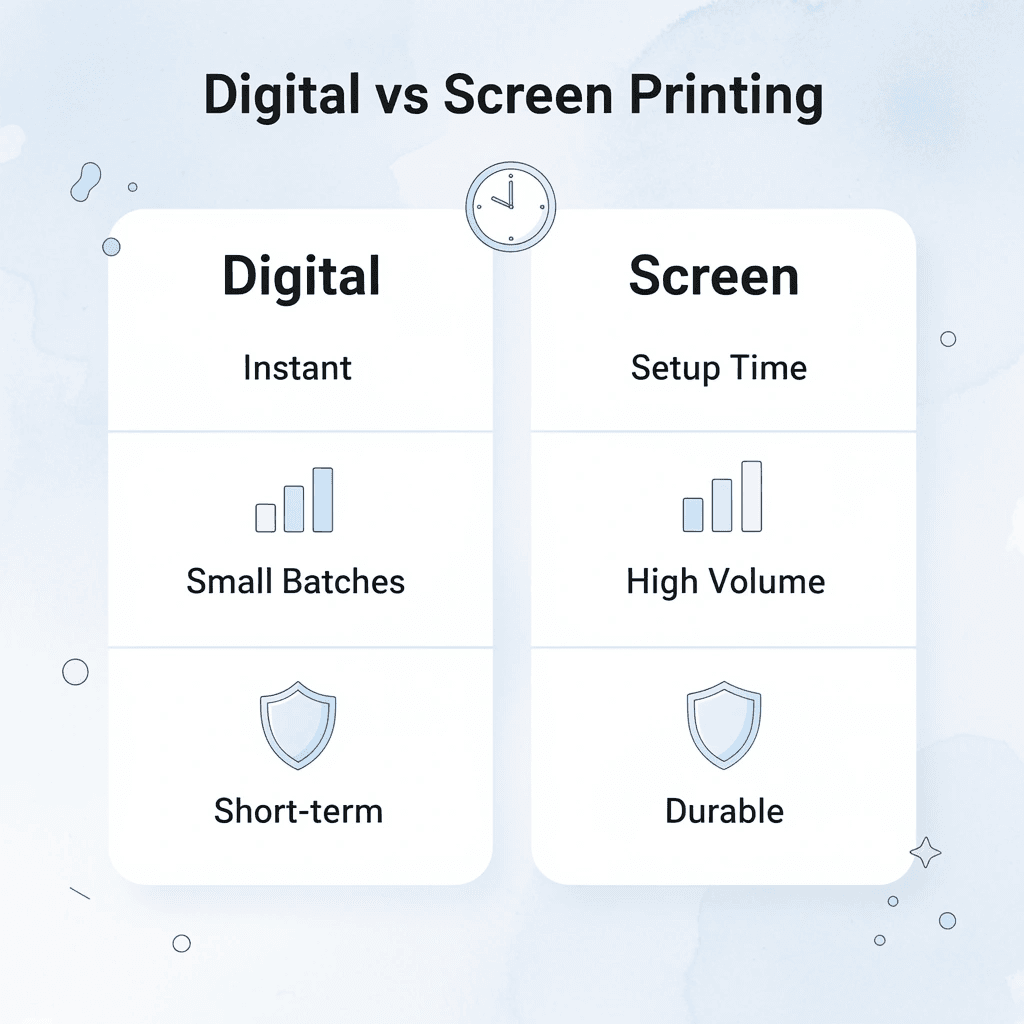
Digital printing sends artwork straight from a computer to a garment in seconds. Screen printing builds physical stencils that layer ink through mesh screens. Digital printing eliminates setup time, while screen printing requires more preparation. However, screen printing delivers superior durability and vibrancy at volume and produces results that water-based inks cannot match.

| Feature | Digital Printing | Screen Printing |
|---|---|---|
| Setup Time | ✅ Instant – seconds | ❌ Requires preparation |
| Best For | Small batches, complex designs | High volume orders |
| Durability | Good for short-term use | ✅ Superior longevity |
| Ink Vibrancy | Standard quality | ✅ Exceptional vibrancy |
| Cost Per Unit | Higher for large orders | ✅ Lower at volume |
🎯 Key Point: Digital printing excels for quick turnaround and small quantities, while screen printing dominates when you need maximum durability and are printing large volumes.
“Screen printing delivers superior durability and ink vibrancy that digital methods struggle to match, especially for high-volume production runs.” — Printing Industry Research, 2024
🔑 Takeaway: Choose digital printing for immediate needs and complex artwork, but select screen printing when longevity, vibrant colors, and cost efficiency at scale matter most.

Production Speed and Workflow
Digital printing starts the moment you upload a file: no screens to burn, color separations to line up, or test runs to check registration. You can print a single shirt, check the result, adjust the design, and print another within minutes.
Screen printing requires creating a separate mesh stencil for every color, coating it with photo-sensitive emulsion, exposing it under UV light, washing out the stencil, and aligning all screens with precision before the first shirt touches ink. This setup takes hours or days, depending on complexity.
Which method prints faster for large orders?
Once screens are ready, screen printing moves fast: a skilled printer can produce hundreds of shirts per hour, as each color layer takes seconds to squeegee and cure.
Digital printing maintains the same steady pace whether printing one shirt or one hundred, since each garment requires individual loading, pretreatment, printing, and heat curing. Screen printing becomes faster at around 50-100 units, depending on the number of colors.
Design Complexity and Color Handling
Digital printers reproduce photographic images, gradients, and unlimited colors in a single pass without additional cost or setup. Screen printing charges for each color because each requires a separate screen, setup time, and ink mixing. A six-color design means six screens, six alignments, and six passes through the press. Complex artwork with gradients or fine details is expensive or technically impossible to produce with traditional screen methods.
What advantages do screen-printed colors offer over digital?
That limitation creates screen printing’s greatest strength. Solid colors printed through mesh screens deliver opacity and saturation that digital inks cannot replicate, especially on dark fabrics. Whites remain crisp. Reds pop with intensity. Specialty inks like metallics, puff additives, and glow-in-the-dark formulas work only with screen printing because they require the thickness that mesh stencils provide.
Cost Economics and Break-Even Points
Digital printing costs the same per shirt regardless of order size because there’s no setup cost. Screen printing requires upfront setup costs, making small orders expensive but large runs cheaper.
A 12-shirt order costs $18 per shirt with screen printing, but $12 per shirt with digital printing. A 500-shirt order drops screen printing to $6 per shirt while digital remains near $10.
When should you choose digital printing for cost savings?
Most teams start with digital printing for samples, prototypes, or small batches because paying $200 for 20 shirts beats paying $400 in setup fees alone.
Platforms like ooShirts show when screen printing becomes more cost-effective for your specific design and quantity, letting you choose the method that saves money without sacrificing quality.
Physical Feel and Appearance
Digital prints feel soft because water-based inks soak into fabric fibers rather than sitting on top. The fabric breathes normally and doesn’t stiffen after printing. Screen prints create a raised, textured layer you can feel and see, especially with white or light-coloured inks on dark shirts. That thickness signals quality to many buyers who associate the classic screen-printed feel with premium apparel.
How does Digital Print Shirt vs Screen Print appear on different fabric colors?
The visual difference shows most clearly on dark fabrics. Digital printing on black shirts requires heavy white pretreatment that can leave a faint rectangular outline around designs if not applied perfectly, whereas screen printing lays down opaque white ink that completely covers the base fabric with no ghosting or undertones. Light-colored shirts hide these differences, making the soft hand of digital printing more appealing for retail-quality garments.
Which printing method offers better long-term durability?
Choosing between a soft hand feel and bold opacity matters only if you understand which method survives repeated washing, stretching, and daily wear over months or years.
Related Reading
- Business T-Shirt Design Ideas
- Types of T-shirt Printing
- T-shirt Design Size
- How To Print A Picture On A Shirt
- T Shirt Colors for Printing
- Best Corporate Apparel Companies
- Best T-shirt Material For Printing
- Best File Type For T-shirt Printing
- Family Reunion T-shirt Ideas
- T-shirt and Ink Color Combinations
- T-shirt Screen Printing Design Ideas
Which Option Is Better and Cost-Effective for Businesses?
DTG printing costs less for orders under 30 shirts or designs with multiple colors. Screen printing suits orders of 50 or more shirts with simple designs, cutting the cost per shirt in half and producing prints that outlast DTG prints.

🎯 Key Point: The break-even point between DTG and screen printing typically occurs around 30-50 shirts, making order volume the primary factor in cost-effectiveness decisions.
“Screen printing can reduce per-unit costs by 50% for large orders while offering superior durability compared to DTG methods.” — Industry Analysis, 2024
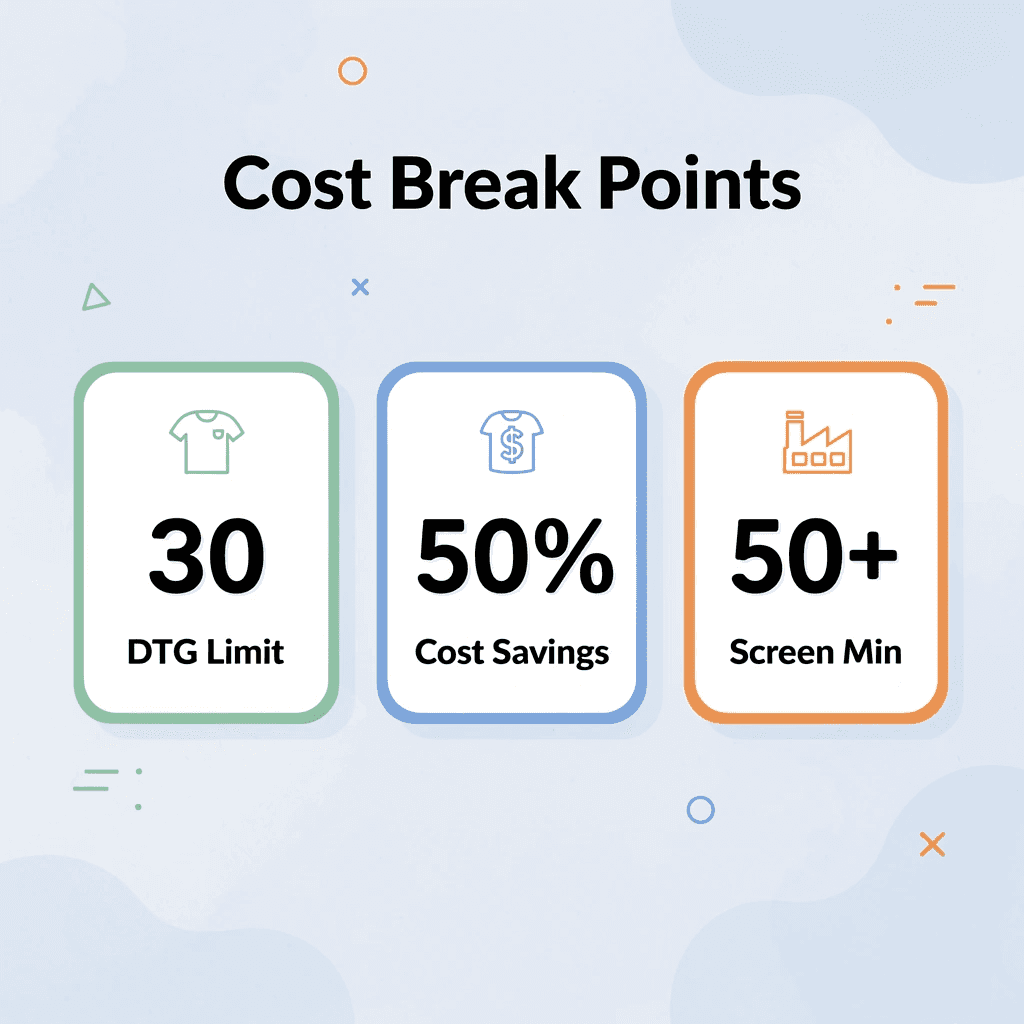
| Printing Method | Best For | Cost Advantage | Durability |
|---|---|---|---|
| DTG Printing | <30 shirts, complex designs | Lower setup costs | Good |
| Screen Printing | 50+ shirts, simple designs | 50% lower per unit | Excellent |
💡 Tip: For businesses with mixed order sizes, consider DTG for small batches and rush orders, while using screen printing for bulk orders and repeat designs to maximize cost savings and profit margins.
How Order Volume Changes Everything
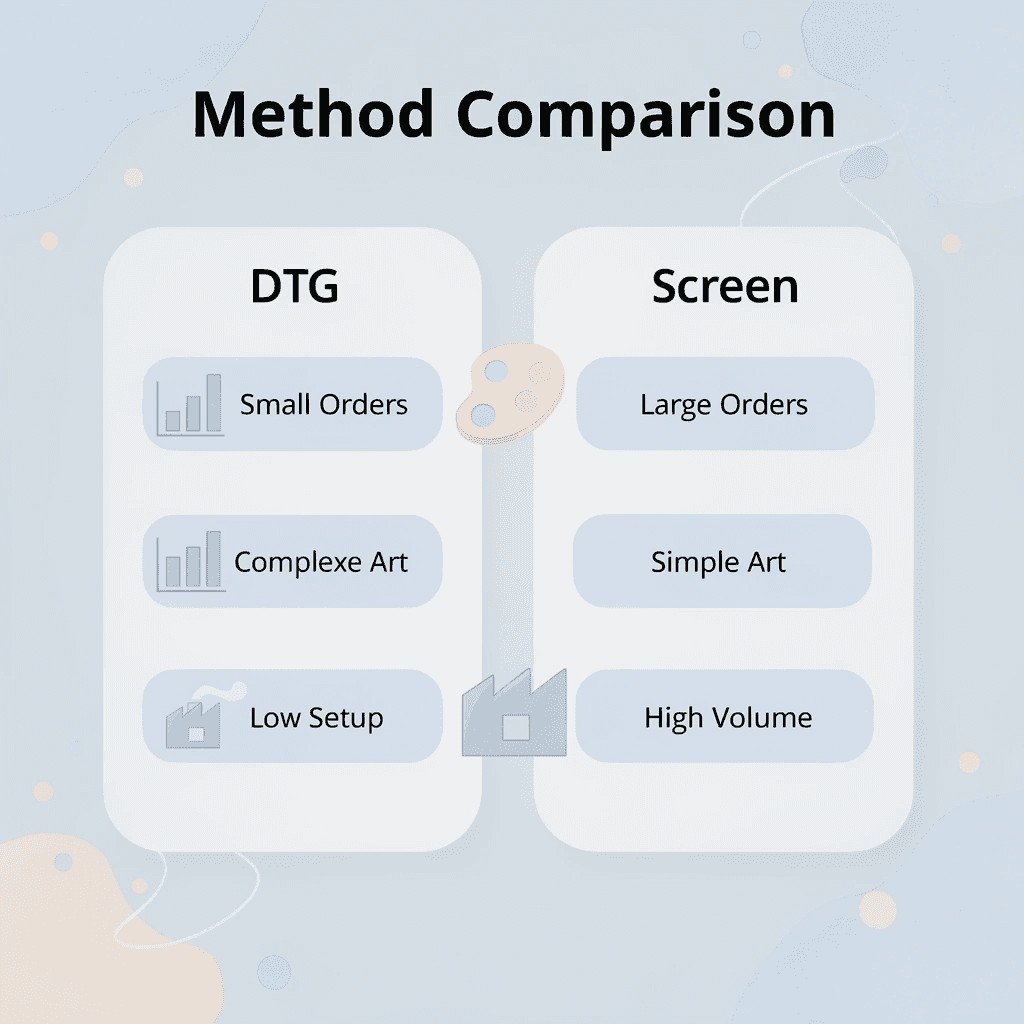
Screen printing’s economics vary significantly with volume. Printing fewer than 24 shirts means setup fees exceed printing costs, making each shirt expensive. Printing more than 72 shirts spreads those setup costs across more units, reducing the price per shirt to $3 or less for basic designs. Businesses printing the same logo on 200 shirts every three months save thousands annually. However, companies that fill custom orders of 5 to 15 shirts often lose money due to setup delays and minimum-quantity requirements.
Design Complexity Drives Hidden Costs
DTG pricing remains constant whether you print single-color text or full-spectrum photographs. Screen printing charges $15 to $45 per additional color because each requires its own screen, registration setup, and ink mixing. A four-color gradient logo costs $8 per shirt with DTG printing but $12 per shirt with screen printing at 50 units, dropping to $5 per shirt at 300 units. Businesses selling artistic apparel with detailed graphics find that DTG better protects profits, while corporate clients ordering two-color polos in bulk achieve lower unit costs with screen printing.
Turnaround Speed Affects Cash Flow
DTG printing eliminates screen preparation, fulfilling rush orders within 48 hours, and reducing inventory risk by printing only what customers buy. Screen printing requires three to five days of setup before production begins. DTG suits seasonal campaigns and design testing, while screen printing’s bulk efficiency benefits established brands with predictable demand.
Durability Impacts Customer Lifetime Value
Screen-printed shirts last through 50 or more washes with minimal fading because thick plastisol ink bonds permanently to fabric. DTG prints show wear after 25 to 30 washes as water-based inks fade over time.
For work uniforms or team gear worn weekly, screen printing reduces replacement frequency and lowers complaint rates. Fashion pieces worn occasionally benefit from DTG’s soft feel and bright detail, despite shorter durability.
Which printing method offers better cost flexibility?
ooShirts removes friction by offering both DTG and screen printing with no minimum orders and guaranteed low prices, whether you need one sample shirt or a thousand event giveaways. Their custom T-shirts let you choose the method that fits your volume and design, not the one a vendor pushes to maximize profit.
Price per shirt only tells half the story when quality standards determine whether customers return or request refunds.
Related Reading
- 4imprint Competitors
- Printify Alternatives
- Redbubble Alternatives
- Rush Order Tees Vs Custom Ink
- Zazzle Alternatives
- Vistaprint Vs Custom Ink
- Vistaprint Alternatives
- Redbubble Alternatives
- Bonfire Competitors
- 4imprint Vs Vistaprint
How ooShirts Ensures High-Quality Digital and Screen T-Shirt Printing
ooShirts checks every piece of clothing before sending it out, examining fabric quality, print durability, and color match to your approved design. If anything falls short of our standards, we reprint the whole order for free—a promise we can make because we’ve produced over 10 million shirts since 2007.
🎯 Key Point: Our quality control process ensures that every shirt meets strict standards before it reaches your door, with zero-cost reprints if anything falls short.
💡 Best Practice: We examine three critical factors in our quality assurance: fabric integrity, print adhesion, and color accuracy—because one weak link can compromise your entire order.

How do premium materials affect Digital Print Shirt vs Screen Print quality?
The foundation starts with fabric selection and ink chemistry. DTG printing requires pre-treatment solutions that bond water-based inks to cotton fibers without stiffness or cracking. Screen printing demands plastisol or water-based inks thick enough to create opaque layers that withstand industrial washing.
ooShirts tests ink formulations on each fabric type, adjusting viscosity and cure temperatures because synthetic fibers repel water-based inks while natural fibers absorb them.
Why is pre-production testing crucial for print accuracy?
Before printing, proofs catch design problems before they reach the press. A nonprofit submitted a logo with RGB colors that would print muddily on dark shirts.
The design team converted the files to CMYK and adjusted color brightness to match the brand guidelines exactly, preventing the frustration of receiving 200 shirts that looked nothing like the on-screen version.
How do curing temperatures affect Digital Print Shirt vs Screen Print durability?
Heat application determines whether prints last three washes or three hundred. DTG designs pass-through conveyor dryers at 320-350°F for 60-90 seconds to harden inks into fabric. Screen-printed shirts are cured in infrared or gas dryers at 300-330°F because thicker ink layers require deeper heat penetration.
What happens when curing goes wrong?
Prints that are not fully cured will peel after washing, while prints that are overcured will crack from brittleness. Our ooShirts equipment is checked and calibrated daily, and we test print durability on samples from each production run.
According to DataIntelo’s Custom T-shirt Printing Market Research Report, the industry was valued at $4.8 billion in 2025 and is growing at a 7.5% CAGR, driven by demand for durable, high-quality prints commanding premium pricing.
How do quality checks ensure consistent results?
Every order passes through inspection stations where staff check print registration (color alignment in multi-layer designs), monitor for ink bleed or ghosting, and verify garment sizes match specifications. Digital systems track each shirt by SKU, flagging problems such as inconsistent color density across batches.
When a school ordered 144 spirit shirts, and three came out with misaligned graphics, those three were pulled and reprinted before the box shipped. The customer never had to request the correction because the system caught it first.
What communication and support options are available?
ooShirts accelerates production through efficient workflows rather than cutting quality steps. Standard turnaround remains 7-10 business days with free shipping, while rush options shorten timelines without compromising inspection protocols.
Customer support is available seven days a week through phone, email, and chat, answering technical questions about file resolution, explaining color shifts on different fabrics, and providing order tracking.
Start Designing Your Custom Shirts Today
Choosing the wrong printer means missed deadlines, faded colors after the first wash, or hidden fees that double your budget. These mistakes damage credibility with your team, customers, or event attendees.

🎯 Key Point: Professional printing quality makes the difference between shirts that impress and shirts that embarrass.
ooShirts removes that risk. Our platform reviews every design file, recommends the most cost-effective printing method based on your quantity and artwork, and produces shirts that stay vibrant wash after wash. You get free shipping, free setup on screen printing, and a low price guarantee that matches any competitor’s quote. Standard delivery takes 10 business days, with rush options available.
“Professional-grade printing with guaranteed color retention and competitive pricing — that’s the ooShirts advantage for custom shirt success.”
| ooShirts Benefits | Details |
|---|---|
| Free Services | Free shipping + Free screen printing setup |
| Quality Guarantee | Vibrant colors that last wash after wash |
| Pricing | Low price guarantee matches competitors |
| Delivery | 10 business days standard, rush available |
Start your design now at ooShirts and get an instant quote comparing DTG and screen printing side by side. No credit card required. Your shirts arrive on schedule with professional-looking prints, guaranteed.
💡 Tip: Compare DTG vs screen printing quotes instantly to find the cost-effective option for your order size and design complexity.

Leave a Reply