Last updated: October 12, 2026
Your team name shapes cohesion, donor response, and event-day energy before anyone takes a single step. Here is how to stop guessing and pick one your whole group will actually own.
Your walking team name is the first decision your group makes together, and it does more work than most organizers expect. The common assumption is that more name options automatically lead to a better choice. If you’re stuck, you just need a bigger list. But before anyone shows up to the starting line, that name is already shaping how members feel about joining, how donors respond to a fundraising page, and whether your group stands out or disappears into a sea of registration numbers. If you want your team to look cohesive from day one, the name and the cheap custom t-shirt printing that carries it both need to be chosen with intention.
Published in Team Cohesion: Advances in Psychological Theory, Methods and Practice, shared symbols and labels serve as cohesion anchors: they give members a concrete referent for “we-ness” and signal to outsiders that the group is a unified entity, reinforcing internal commitment. Groups that lack meaningful identity markers exhibit lower task and social cohesion, because members have no symbolic focal point around which to organize collective effort. A generic label, “Team 4” or “Walking Group B,” undermines differentiation from the start and gives members nothing to rally around.
For charity and walking event teams, the stakes are higher still. A name like “Stride for Sarah” tells every potential donor exactly who the walk is for and why it matters. A forgettable name is a missed fundraising lever, forcing every team member to do extra work explaining the cause in conversations the name should have started for them. A name chosen carelessly is a group identity left on the table.
Key takeaways
- Your team name is the first filter potential members use, a name that signals the wrong vibe kills sign-ups before the kickoff email gets read.
- The bottleneck in picking a name is never a shortage of options; it’s not knowing your group’s vibe and goal before you start evaluating any of them.
- Funny names aren’t a soft choice, teams that build humor into their identity report up to 31% higher productivity than those that don’t.
- On a fundraising leaderboard, your team name appears before your story, your photo, and your donation link, which makes it a direct driver of whether strangers click and give.
- Matching shirts aren’t just aesthetic, finish line photos show that the teams people remember are the ones wearing their name on their chest.
- ooShirts closes the execution gap: once your name is locked, their cheap custom t-shirt printing with free shipping and setup means a small walking group can go from name to matching shirts without a bulk-order commitment or a budget crisis.
What Makes a Good Walking Team Name Hard to Get Right
The common assumption among walk team organizers is that more name options automatically lead to a better choice; if you’re stuck, you just need a bigger list. In reality, three constraints collide the moment a group tries to name itself for a walk: the name has to fit a race bib, land with people who barely know each other, and, for charity events, carry emotional weight that moves donors to open their wallets. Understanding why those constraints conflict is more useful than any list.
Why Inside Jokes and Generic Placeholders Both Backfire
Both extremes fail for the same underlying reason. As the Epilepsy Foundation Walk to END EPILEPSY event page makes clear, teams drawn from families, coworkers, and community members span wildly different backgrounds, so insider references risk alienating members who don’t share the same relationship to the cause. Generic placeholders, meanwhile, give donors nothing to connect with and give teammates nothing to rally around.
The Charity Walk Creative Brief Is Harder Than It Looks
Most teams underestimate how much a name has to do at once. The ALS Association Walk to Defeat ALS FAQ sets the same bar as the Epilepsy Foundation Walk to END EPILEPSY: teams must balance fun, camaraderie, and cause-reinforcement simultaneously, a creative brief that generic or purely humorous names fail to satisfy.
That bar is worth keeping in mind when evaluating options. Teams we work with at ooShirts routinely discover that seeing the name on an actual shirt proof, with a good-looking, quality print, is the fastest way to pressure-test whether the name they chose actually carries the weight they intended. With more than 100 shirt styles to choose from and no minimum order requirement for direct-to-garment printing, teams can experiment with a small run before committing, without absorbing the cost of an order nobody wanted.
The Committee Trap
Group decision-making research consistently shows that voting by committee produces compromise outcomes: each round of feedback sands off the edges until what remains is inoffensive but forgettable. Resolving the cost question early is one reliable way to short-circuit that dynamic.
Teams we work with at ooShirts sidestep this because of professional screen printing that produces vibrant, long-lasting prints. Most cost-effective for orders of 12 or more shirts and ideal for bold graphic designs with up to 8 colors, the cost question answers itself early and the group’s energy stays on the name and the cause.
How to Choose a Walking Team Name Your Whole Group Will Own
Work through the process below and you will have a name your whole team owns, and one worth putting on a shirt.
Lock In Your Vibe Before You Browse a Single Name
A walking team name chosen through a structured elimination process, one that defines the group’s vibe and goal before evaluating options, produces faster consensus and stronger collective ownership than any expanded list of name suggestions. The bottleneck is the absence of shared criteria, not a shortage of options.
Meetings’ 2023 framework: a defined set of criteria applied before evaluating options leads to better decisions than open-ended brainstorming without constraints. Start by having every team member pick one vibe from this shortlist:
- Funny/punny
- Motivational
- Cause-driven
- Cool/creative
Match the Name’s Register to the Event’s Real Goal
A charity walk and a company step challenge are not the same creative brief, so the winning vibe category from your vote should be filtered through the event’s actual purpose before you evaluate a single name.
The Three-Question Test Every Finalist Must Pass
Once you have two or three names that fit the vibe, run each through three fast checks. Does it fit a bib? Most race bib fields cap team names at roughly 20 to 25 characters, so count carefully before you fall in love with a longer option.
Funny Walking Team Names That Win the Crowd Every Time
Shared laughter is not a soft metric. According to the Windhoek Observer‘s 2024 analysis of humor in team-building contexts, teams that incorporate humor into their culture report up to 31% higher productivity than those that don’t. That number reframes the funny walking team name from a lazy fallback into a deliberate identity move. The organizer who chooses humor intentionally is picking the one tool that builds cohesion across people with no shared background, no common expertise, and nothing in common except the fact that they are all about to walk several miles together.
The same Windhoek Observer research confirms that shared humor functions as a social bonding mechanism that lowers interpersonal barriers across age groups and departments. That is the structural reason puns outperform inside jokes as a naming strategy. An inside joke rewards the people who already belong and quietly excludes everyone else. A walking pun costs nothing to decode. “Sole Survivors” lands for the 22-year-old intern and the 58-year-old department head at exactly the same moment, which is what makes it unifying rather than merely amusing.
The practical filter that follows from this: audience-safe humor tied to a shared experience beats clever humor aimed at a subset. Step challenge team names that riff on the act of walking, the pain of blisters, or the absurdity of counting steps all clear this bar. Names that punch at a specific person, body type, or department do not, and the Windhoek Observer research is direct on this point: inclusive humor unifies while targeted humor damages trust.
Most organizers already sense this, which is why they spend forty minutes in a group chat trying to find something that offends no one and excites everyone. The problem is having no shortlist to apply the filter to. The 15 names below are chosen to pass that filter out of the box, so your group can pick one in under five minutes and spend the rest of the planning energy on the event itself.
One practical note before the list: once your group lands on a name, the next instinct is usually to print matching shirts, followed immediately by the sinking realization that most printers require a minimum order that punishes a team of seven. ooShirts has no minimum order requirement for DTG printing, which means a group of any size can order exactly the number of shirts they need, no overage, no waste. If you find a lower price elsewhere, ooShirts will match it.
What organizers running a one-time walk often don’t realize until it’s almost too late is that headcounts shift. A teammate drops out; two colleagues add themselves the week before the event. Jessie Creighton of Gorham, Maine ran into exactly this problem when she ordered custom shirts for her grandmother’s surprise birthday party, a one-shot event with a fixed, unmovable date.
Partway through her order, her count changed, the way it always does when you’re collecting sizes from a group. Instead of forcing her to restart, the ooShirts team adjusted the order over the phone and rushed it so it would arrive before the party. She rated print quality and service 5/5 and specifically called out the phone support and the willingness to absorb the size change late in the process.
Customer support is available 7 days a week for exactly this reason: a person on the phone rerunning your order is what makes the event happen on time, and a guaranteed delivery date means you can commit to your walk date before you commit to your shirt design.
Why Puns Work Across Every Age Group on Your Walking Team
Puns work across age groups because they operate on a single shared language: the English word with two meanings. No cultural membership is required. According to industry data, Society’s research on team cohesion shows that shared humor and informal communication reduce interpersonal distance and increase group cohesion, making light-hearted shared identifiers effective tools for unifying diverse group members. That is the mechanism behind every name on this list: the laugh is the handshake that skips the small talk.
1. The Pavement Pounders – Classic Pun That Lands Every Time
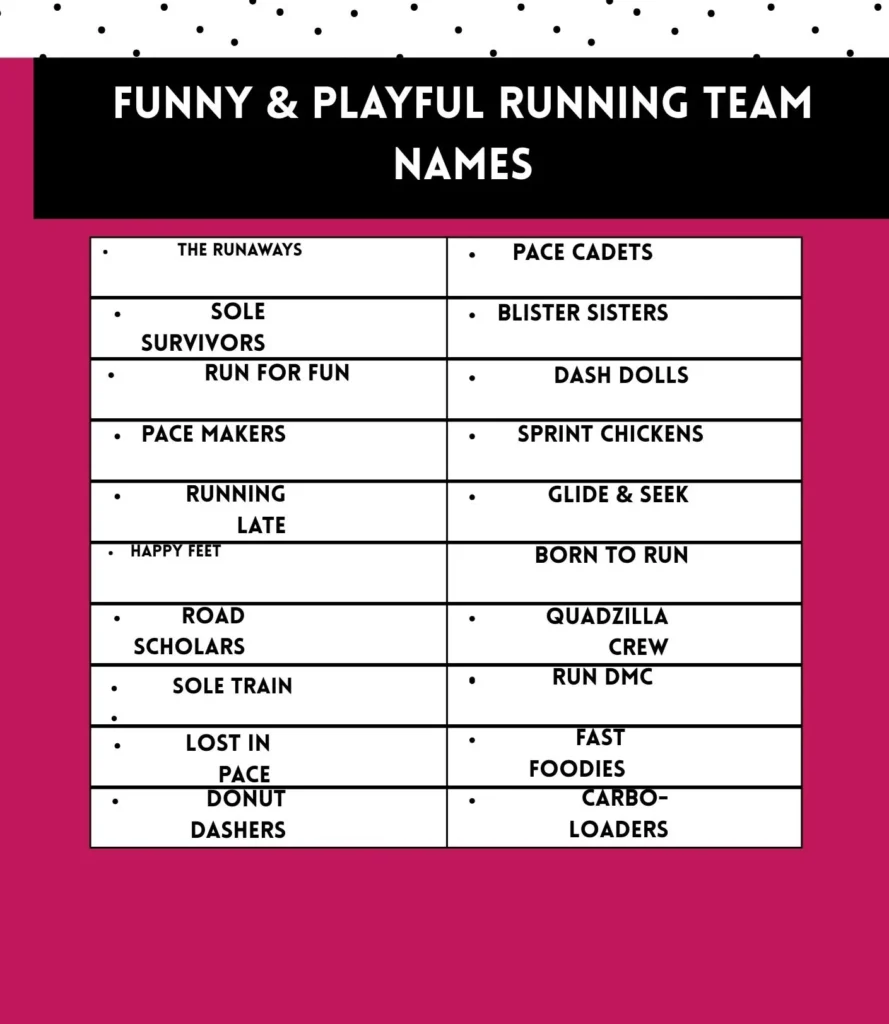
The alliteration makes it easy to chant, easy to print on a bib, and impossible to mishear across a crowded start line. It fits every walk format, from a corporate step challenge to a community 5K, and carries zero risk of alienating a mixed-age group. The one tradeoff: it is common enough that another team at a large event may have had the same idea.
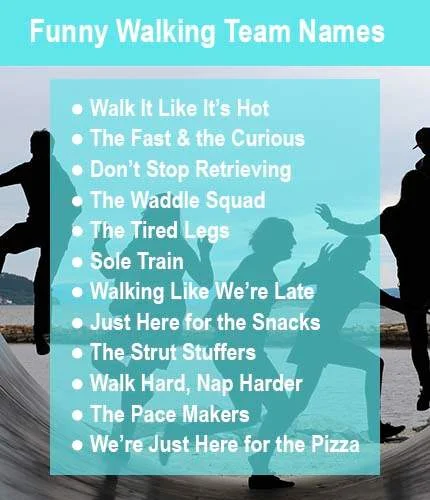
2. Sole Survivors – Pop-Culture Wordplay With Universal Appeal
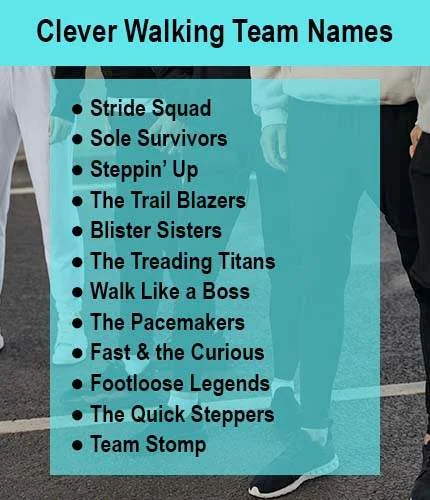
The Survivor reference is old enough to be nostalgic and young enough to still register, which gives this name genuine cross-generational pull. The shoe-sole pun does the heavy lifting for anyone who missed the TV reference entirely, so the name works on two levels simultaneously. It photographs well on shirts and reads instantly on a race bib. Best pick for a group that wants to sound like they put thought into it without spending more than thirty seconds brainstorming.
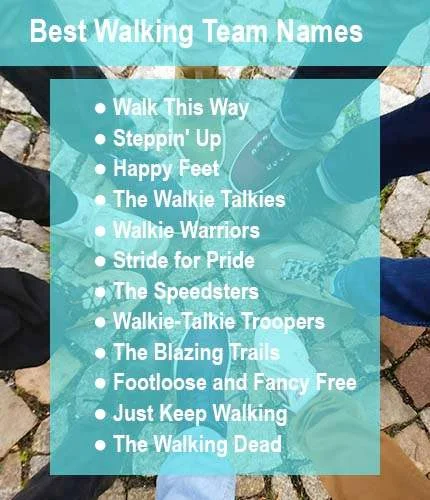
3. Walk This Way – The Rock-Pun Name That Gets a Crowd Singing
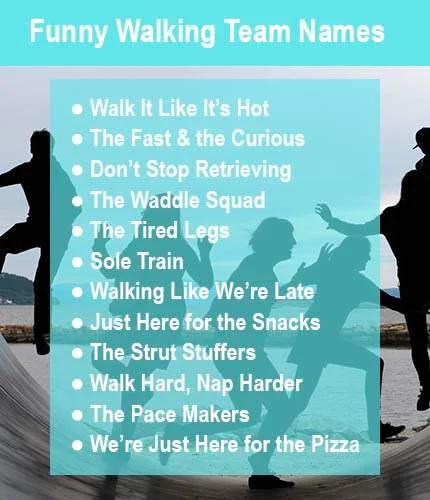
Aerosmith’s catalog is one of the few shared cultural touchstones that genuinely spans Baby Boomers through Gen Z, which makes this name unusually safe for multigenerational workplace teams or community events. Spectators will hum it involuntarily when they read your bib, which is exactly the kind of crowd reaction that makes your team the one people remember at the finish line. The limitation is brevity: it says nothing about your cause or company, so it works better for pure fun events than for charity walks where the name should carry meaning.
4. Blister Sisters – Relatable Humor That Bonds the Team Instantly
The name earns its place by naming the shared suffering every walker already anticipates. Relatability is the fastest path to group identity, and blisters are the universal tax on any walk longer than two miles. “Sisters” skews the name toward female-identifying teams, which is worth noting for mixed-gender groups; “Blister Misters” or “Blister Siblings” are easy swaps that preserve the joke without narrowing the audience. Choose this one when your team already has a tight bond and wants a name that signals self-aware humor over athletic pretension.
5. Ctrl + Alt + De-Feet – The Tech-Pun Name Built for Office Step Challenges
This is the strongest entry in the funny walking team names for work category because it does two things at once: it signals that the team works in a tech-adjacent environment and it lands the foot pun cleanly. HR will approve it without a second read. It prints beautifully on a shirt and reads fast on a leaderboard. The tradeoff is context-dependence; outside a corporate or tech setting, the keyboard reference loses half its punch and the name becomes a spelling puzzle.
6. The Shuffling Dead – Halloween-Themed Name That Owns the Slow-Walk Joke
Walking events held in October have a natural home in this name, but it works year-round for any team that wants to lean into the “we are not runners” identity with confidence. The zombie reference is mainstream enough to need no explanation, and the self-deprecating angle makes it immediately likable to spectators. It is the rare funny name that gets funnier the slower your team walks, which removes any performance pressure entirely. Avoid it if your event has a serious cause-awareness tone; the undead framing can feel tonally mismatched on a memorial walk.
7. Humor as the Most Inclusive Tone for Walking Team Names – Why Puns Beat Trash Talk
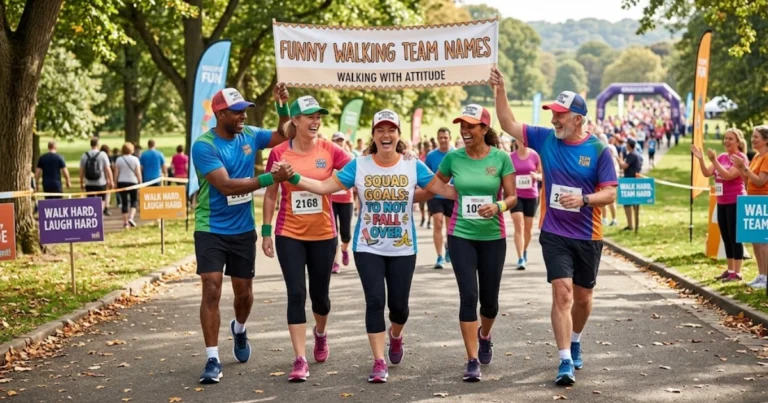
Light puns and wordplay are the single most broadly inclusive humor style for walking team names because they require no shared background, target no individual, and land across age groups from elementary school kids to grandparents. Unlike edgy or sarcastic names, pun-based funny walking team names rarely alienate anyone, making them the default-safe choice for mixed groups. The one limitation: very gentle puns can feel forgettable without a strong visual identity to back them up.
8. Keep It Safe-for-All-Audiences – The Non-Negotiable Rule for Funny Walking Team Names
The funniest walking team names avoid body-shaming language, profanity, and references that exclude or demean, especially critical in corporate wellness events, school fundraisers, and community charity walks where HR policies or parental oversight apply. A name that gets a laugh from half the crowd while making the other half uncomfortable is a net loss. The practical rule: if you’d hesitate to say it to a new colleague on day one, choose a different name.
9. Funny Walking Team Names for Work – A Refined Subset Worth Treating Separately
The Windhoek Observer‘s 2024 analysis is explicit: humor that targets shared neutral experiences unifies, while humor that singles out individuals or physical traits damages trust. For humorous team names, this translates to a simple test before you commit: would this name make anyone on the team wince quietly and say nothing? If yes, it is humor with a victim. Walking puns, office-life jokes, and gentle self-deprecation about the act of walking all clear the bar. Names that reference body size, age, or specific people do not.
10. Walkie Talkies – The Playful Retro-Tech Pun Everyone Recognizes
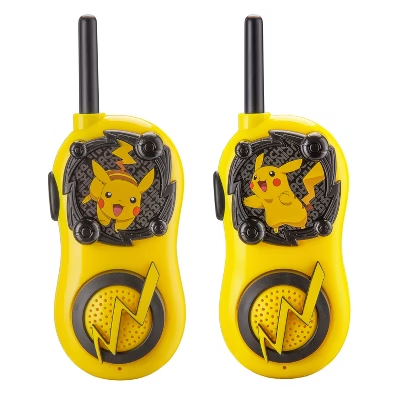
Simple, clean, and completely age-agnostic. The walkie-talkie reference is old enough to feel nostalgic and universal enough to need zero explanation. It works for any group size, fits on a bib without truncation, and doubles as a subtle nod to the idea that your team communicates well. The limitation is that it is almost too gentle; for a group that wants to signal personality and edge, “Walkie Talkies” may read as the safe choice rather than the memorable one. Best fit for mixed-age community events or low-key corporate wellness challenges.
11. Wok This Way – The Foodie Pun That Doubles as a Conversation Starter
The food-walk pun works on a practical level that most name lists overlook: it gives your team an instant post-walk talking point and a natural excuse to plan a meal together after the event. That kind of built-in social script makes the name do active culture work beyond the event. It is a strong pick for groups where building relationships across departments is the real goal. The tradeoff is that it relies on the listener catching the Aerosmith echo inside the food pun, which is not guaranteed for every audience.
12. Step Sitters – The Ironic Name That Celebrates the Anti-Athlete Identity
The anti-athlete identity is underused as a naming strategy, and “Step Sitters” owns it without apology. It signals that your team is here for the camaraderie, not the leaderboard, which immediately lowers the stakes and makes the event feel accessible to participants who dread being the slowest. That accessibility signal can meaningfully boost participation in corporate step challenges, where fear of embarrassment is a real barrier for less active employees. The name’s limitation is that it can feel passive for a group that actually wants to compete; read your team before you commit.
13. Blisters and Banter – The Name That Promises Both Pain and Laughs
This name functions as a social contract: you are telling every spectator and fellow participant exactly what kind of team you are before you take a single step. The “and” construction is deceptively effective because it sets two expectations simultaneously, both of which are easy to meet. It works best for groups that already have a strong internal culture and want a name that reflects their actual dynamic. For a brand-new team with no shared history, it can feel aspirational in a way that takes a few miles to earn.
14. Flexi-Walkers – The Gentle Wordplay That Works for All Fitness Levels
It signals adaptability without calling attention to anyone’s pace, which matters for events that mix highly active participants with colleagues or family members who are walking for the first time. The wordplay is light enough that it does not require explanation, and the name reads as warm rather than ironic. The tradeoff is memorability; it is unlikely to be the name the crowd is still talking about at the after-party, which is fine if cohesion rather than crowd recognition is the primary goal.
15. The Spreadsheet Striders – Funny Walking Team Names for Work Done Right
A prime example of the ‘funny walking team names for work’ sub-angle, Spreadsheet Striders pairs the most universally recognized symbol of office drudgery with athletic language, the joke being that even the most desk-bound employees can become striders. It passes HR review effortlessly, works in internal communications, and gets knowing laughs from anyone who’s ever stared at a pivot table. Tradeoff: the humor is niche to office workers and falls flat at non-corporate events.
Walking Team Names for Work That Actually Boost Office Morale
Sign-up forms get filled out in two minutes, but the team name field is where participation decisions actually get made. A colleague scanning the internal challenge page doesn’t read the kickoff email carefully; they look at the team names and decide in seconds whether any of them feel worth joining. Myles Wellbeing’s research confirms that shared goals are what build team spirit in corporate step challenges, and a name is the first signal that a shared goal exists.
The insight that most wellness coordinators miss: relevance beats cleverness every time. A name that makes the finance team laugh won’t recruit anyone from ops. A name that references a tool nobody uses alienates half the floor. RethinkCare‘s analysis of wellness engagement found that programs feel meaningful only when they’re personally relevant to the employees in them, and the same principle applies at the name level. Generic or imposed names produce the same quiet disengagement as a wellness program that offers more options but feels like it was designed for someone else.
Once your team name is locked in and the energy is real, most organizers hit a second wall: outfitting a small or oddly-sized department in matching shirts usually means hunting for a printer willing to take the order. That’s a real friction point, and it’s exactly where ooShirts removes the obstacle. With no minimum orders for DTG printing, a team of three and a team of three hundred place orders on equal footing.
Choose from 100+ shirt styles, lock in all-inclusive transparent pricing with no setup fees, and lean on a price match guarantee if you’re comparing options before committing. For coordinators managing multiple departments or office locations, ooShirts makes it practical to source consistent, repeatable branded merchandise as headcount scales, so every team, at every site, shows up in the same kit without a logistical scramble. Free shipping and setup, a quality guarantee, and guaranteed delivery dates mean you’re not chasing a vendor the week before the challenge kicks off.
And if anything comes up, customer support is available seven days a week.
The twelve names below are built for workplace culture specifically: inside enough to feel like yours, broad enough to include the whole department.
1. The Sole Survivors – HR-Safe Humor That Still Gets Laughs
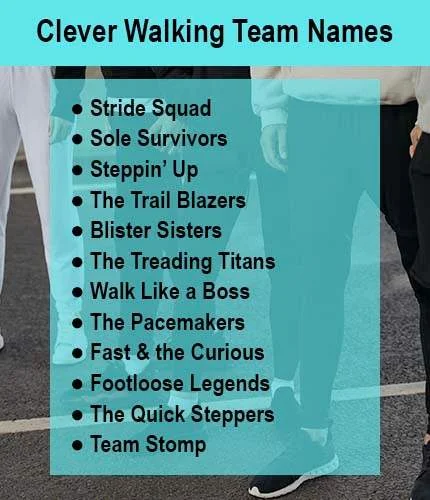
This name works because it is funny without targeting anyone. The gallows-humor framing resonates with employees who have lived through layoffs, reorgs, or brutal project cycles, which is most office workers. It signals self-awareness rather than corporate cheerfulness, which is exactly what cynics need to opt in. Best pick for teams that want to acknowledge workplace reality without making HR nervous. The one tradeoff: it may read as too dark for a company still in a sensitive restructuring period.
2. Ctrl + Walk – The Name for Tech and Remote Teams
Tech workers respond to keyboard shortcut humor because it signals shared identity instantly. This name tells every developer, analyst, and IT staffer that the team was made for them, not adapted from a generic list. It also reads cleanly on a shirt without explanation. The limitation is specificity: in a mixed department where half the team doesn’t live in a terminal all day, the reference lands flat and the name starts to feel exclusive rather than inclusive.
3. Out of Office – The Remote Work Walking Team Name
Remote employees frequently feel like afterthoughts in in-person wellness events, and this name directly acknowledges their reality. It works as a double meaning: physically out of the office and proudly so. For distributed teams or hybrid groups where remote workers outnumber in-office staff, it creates immediate belonging. The tradeoff is that it can feel like a consolation prize if leadership is using it to paper over a challenge that was never actually designed with remote participants in mind.
4. The Mandatory Fun Runners – Self-Aware Office Culture Name
This name does something most corporate wellness names refuse to do: it admits what employees are already thinking. Threads across workplace communities consistently surface the “mandatory fun” complaint as the primary reason people disengage from step challenges before they start. Naming the cynicism directly disarms it. It works best in cultures where leadership has enough psychological safety to laugh at itself. It is the wrong pick for organizations where senior sponsors would read it as an insult rather than a wink.
5. Walkie Talkies – The Collaborative Team Motto Name
Simple, warm, and immediately understood across every age group and department. The name implies that the team communicates as well as it moves, which makes it a natural fit for cross-functional groups or teams that want to project collaboration rather than competition. It reads well on a bib and requires zero explanation. The limitation is that it lacks edge; teams in competitive step challenges who want to signal ambition will find it too soft to serve as a rallying identity.
6. Steppin’ on the Clock – The Productivity-Humor Hybrid
This name threads a needle that most workplace names miss: it references work without being about work. The phrase implies that the team is moving with purpose during hours that are normally spent sitting, which is the exact behavior a step challenge is trying to reinforce. It works best for teams in high-output departments where productivity is a point of pride. The one real tradeoff is that “on the clock” reads differently in hourly-wage environments, where it can carry an unintended pressure connotation.
7. The Hybrid Hikers – Built for Distributed Teams
A substantial share of the U.S. workforce operates on hybrid schedules, and most walking challenge names were written before that reality existed. This name acknowledges the split without making it a problem. It gives remote and in-office participants equal ownership of the team identity, which matters for morale in distributed groups. The tradeoff is that it is descriptive rather than energizing; teams looking for a name with competitive bite will find it too neutral to generate genuine excitement.
8. Deadline Dashers – The High-Performer Walking Team Identity
Deadline Dashers works because it maps directly onto how high-performing employees already think about themselves. The name implies speed, pressure, and delivery, which are identity markers in results-driven cultures. It is specific enough to feel earned and broad enough to include anyone who has ever shipped something under pressure, which covers most of a typical office. The limitation: in teams where burnout is already a concern, a name that celebrates deadline pressure can feel like the wrong message from leadership.
9. Pave the Way – The Team Motto Name for Leadership Buy-In
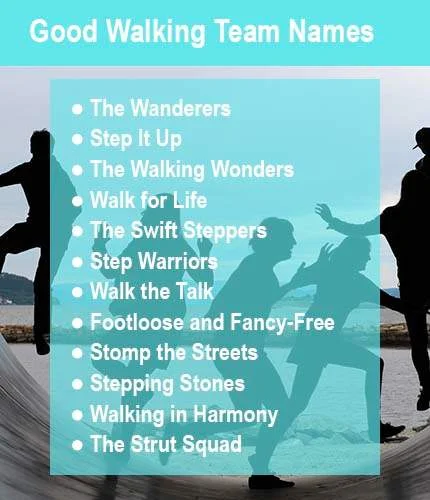
Some names do double duty as team mottos, and this is the strongest example in the workplace category. It signals ambition and forward motion without any departmental specificity, which makes it easy for senior sponsors to adopt and promote. It also photographs well on shirts at the finish line, which matters for internal communications teams capturing the event. The tradeoff is that it can feel aspirational to the point of vagueness; teams that want something with personality rather than polish will find it too polished.
10. No Slack in Our Step – The Internal Tool Inside Joke Name
Inside jokes build team identity faster than any external reference, and Slack is the one tool nearly every office worker shares regardless of department. This name rewards the people who get it immediately and explains itself quickly to those who don’t. It works best in organizations where Slack is genuinely central to daily communication. The limitation is shelf life: if the company migrates platforms or the tool falls out of favor, the name loses its resonance entirely and can date the team awkwardly.
11. Step It Up, Buttercup – The Friendly Competitive Challenge Name
Friendly trash talk is one of the most reliable participation drivers in workplace step challenges, and this name delivers it without crossing any lines. The rhyme makes it memorable and easy to chant, which matters more than most organizers expect once the challenge is actually running. It works across age groups and requires no shared cultural reference. The one tradeoff is tone: in workplaces where the wellness challenge is positioned as supportive rather than competitive, the challenge framing can feel slightly off-brand for the event’s stated goal.
12. The Step-resentatives – Department Pride Walking Team Name
Department identity is an underused asset in workplace wellness challenges. This name gives a team a reason to compete that goes beyond personal fitness: they are representing their department, which raises the social stakes in a productive way. It works especially well when multiple departments are fielding teams and the leaderboard is visible company-wide. The limitation is that it requires a team that actually feels department pride; in siloed or low-morale departments, the name can feel ironic rather than motivating.
A name that boosts office morale is doing one job: making colleagues want to join your team. But when the walk is tied to a cause, the name has to do a second job entirely: open wallets. That’s the challenge the next section tackles head-on.
Related Reading
- Dance Team Names
- Red Team Names
- Cricket Team Names
- Bocce Team Names
- Beer Olympic Team Names
- Animal Team Names
- Pink Team Names
- Fishing Team Names
- Math Team Names
Charity and Fundraising Walk Team Names That Do Double Duty
On a crowded fundraising leaderboard, your team name appears before your story, before your photo, and before your donation link. Participants who feel emotionally connected to their team identity are more likely to actively solicit donations from their personal networks, so meaning-embedded names drive fundraising engagement beyond what generic “Walk for X” constructions can. The name is the first conversion asset a donor encounters.
The practical implication is concrete. A name that instantly signals cause-connection while remaining warm lowers the donation barrier for donors who have never heard of your organization. A name that is curious, specific, or emotionally resonant earns more leaderboard clicks. A name that is forgettable gets scrolled past. The difference between “Team Johnson” and “Miles for Miles” is peer-to-peer fundraising mechanics working in your favor or against you.
The fifteen formats below are built on that principle: every one of them does cause-signaling and memorability at the same time.
1. Miles for [Survivor’s Name]: The Memorial Walk Name Formula That Raises More
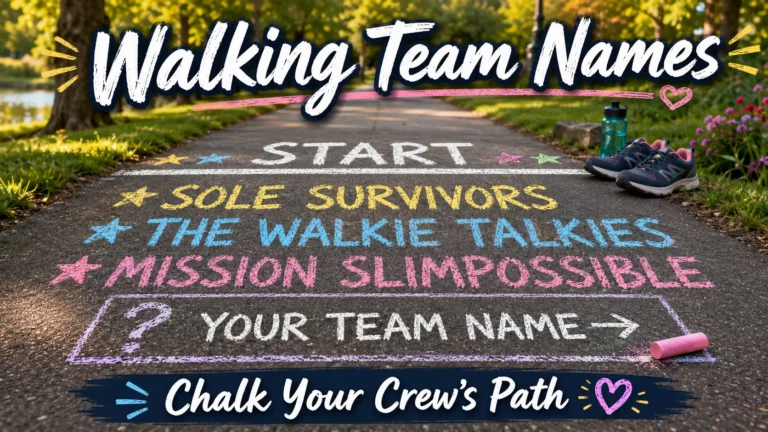
Embedding a real person’s name turns a generic distance goal into a tribute with a face. Donors in a participant’s network who knew the person give more readily because the name removes the “why should I care” friction before they even read the team page. This format works best when the named individual is known to at least part of the team’s personal network; it loses some force when the name is unfamiliar to most potential donors.
2. Stepping Out for Hearts – Cause-Signal-First Heart Walk Team Names
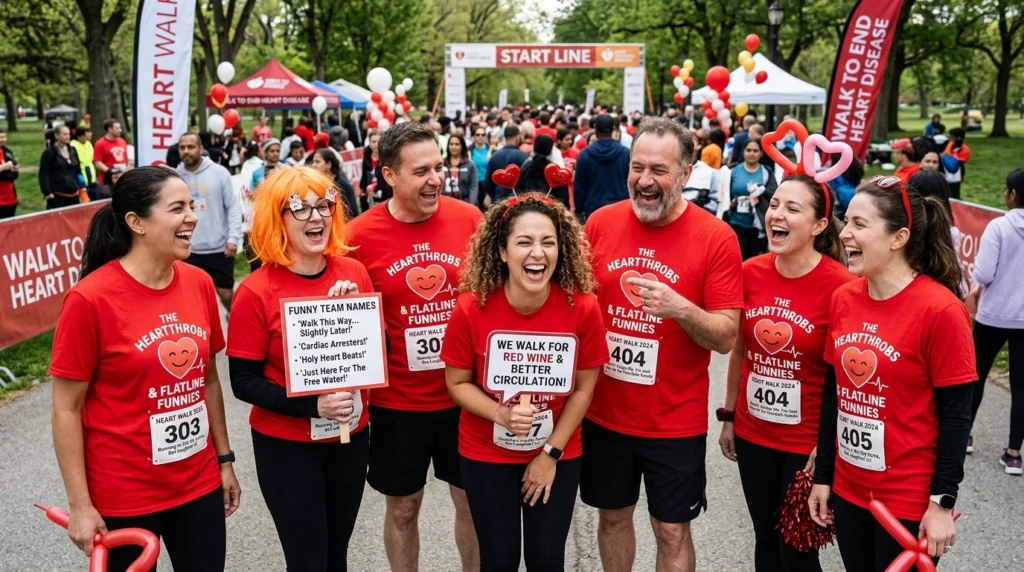
Leading with the action verb (“Stepping Out”) before the cause (“Hearts”) creates a name that reads as momentum rather than a label. It tells donors immediately what the team is doing and why, which is the lowest-friction introduction a peer-to-peer fundraising page can have. The tradeoff is that action-verb constructions can feel slightly generic across large events where many teams use similar phrasing; pairing this format with a specific year or city reference sharpens it.
3. Sole Sisters for Susan G. Komen – Breast Cancer Walk Names That Signal the Cause Warmly
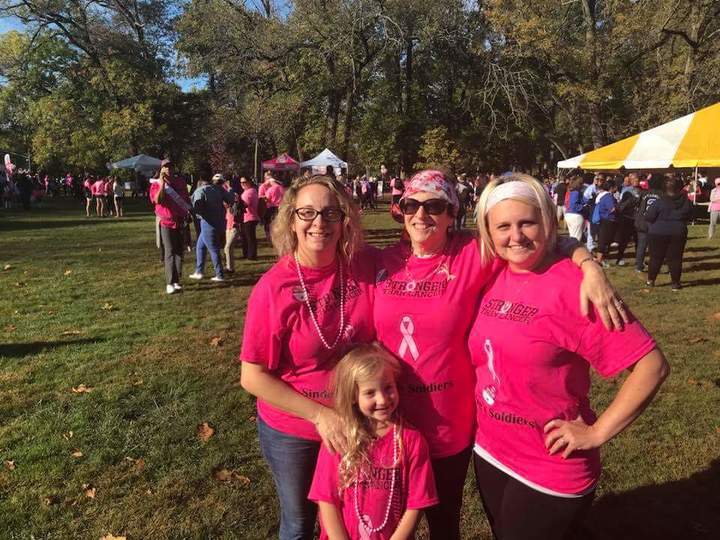
Cause-organization name-drops inside a team name work when the organization is widely recognized, because the brand does the credibility work for you. “Sole Sisters” adds warmth and a light pun; “for Susan G. Komen” anchors the cause for donors who might otherwise wonder where their money goes. The limitation: if your team is mixed-gender, the “Sisters” framing can feel exclusionary, so swap it for “Sole Squad” or “Sole Crew” without losing the mechanism.
4. Walking in [Name]’s Honor – Why Survivor-Named Teams Drive Peer-to-Peer Fundraising Engagement
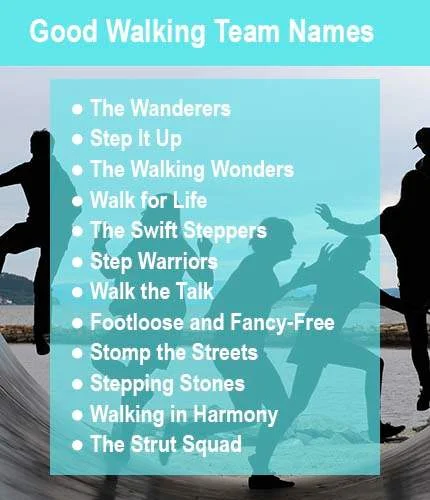
The “in honor of” prefix does something the “in memory of” prefix cannot: it signals that the person is still present, still fighting, and that the donation has a living beneficiary. That distinction shifts the emotional register from grief to solidarity, which tends to convert donors who find grief-forward appeals too heavy. Most effective when the named survivor is willing to share their own story on the team fundraising page, closing the loop between the name and the narrative.
5. Relay Rebels – Unique and Creative Charity Walk Names That Stand Out on Leaderboards
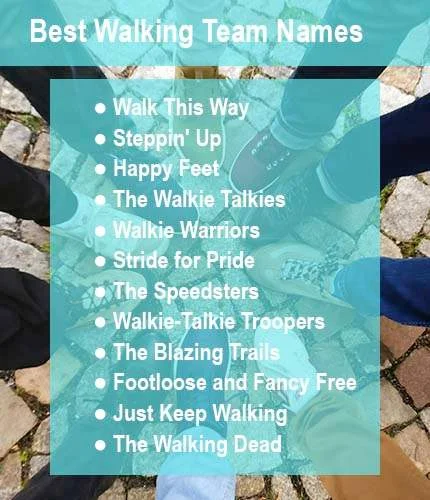
Standout team names on crowded fundraising leaderboards function as micro-marketing assets. “Relay Rebels” earns attention because the alliteration aids recall and the word “Rebels” implies competitive energy without hostility. The format scales to any cause: swap “Relay” for the event type and keep a punchy second word. The risk is that playful names can feel tonally mismatched at deeply solemn events; read the event’s emotional register before committing.
6. The Brenda Dillon Memorial Walk Model – How Named Memorial Walks Build Year-Over-Year Donor Loyalty
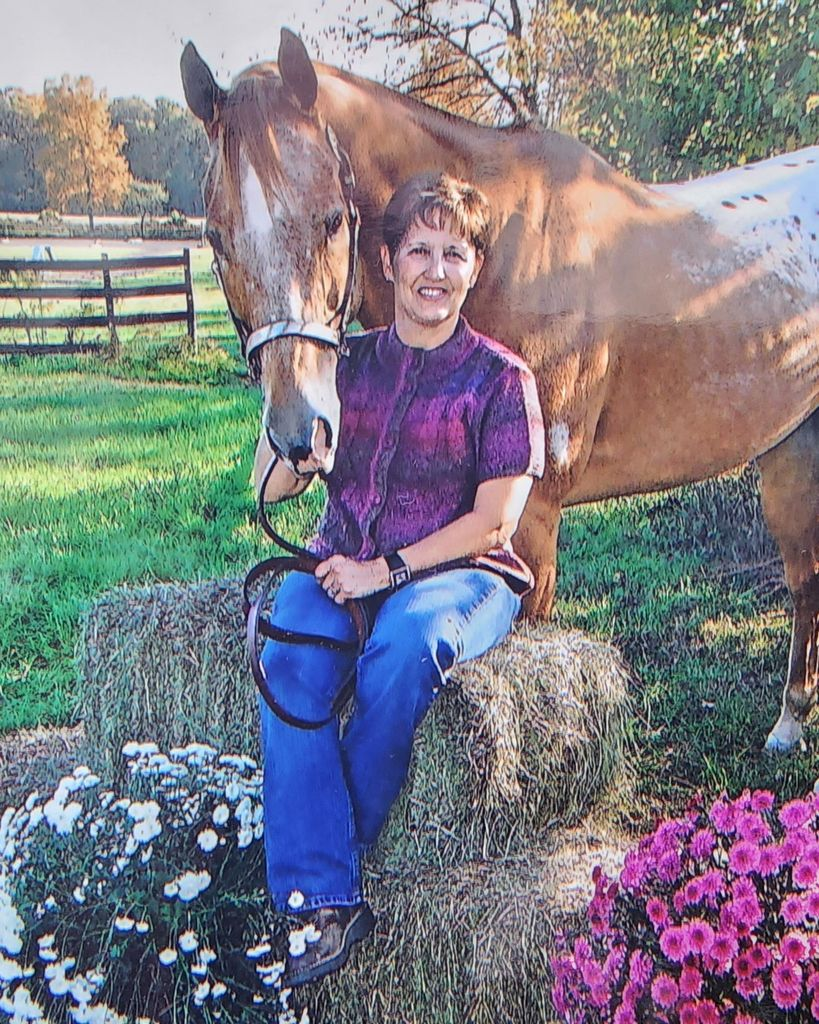
Established memorial walk names, like the ACB’s Brenda Dillon Memorial Walk, demonstrate that naming an entire event after a beloved community figure creates a recurring emotional anchor that donors return to annually. For team naming, adopting this model at the team level (e.g., ‘The Brenda Squad’) transfers that loyalty to the peer-to-peer layer. The limitation is that the honoree must be widely known within the donor community for the name to carry weight.
7. Puns With Purpose – Funny Charity Walk Team Names That Still Signal the Cause
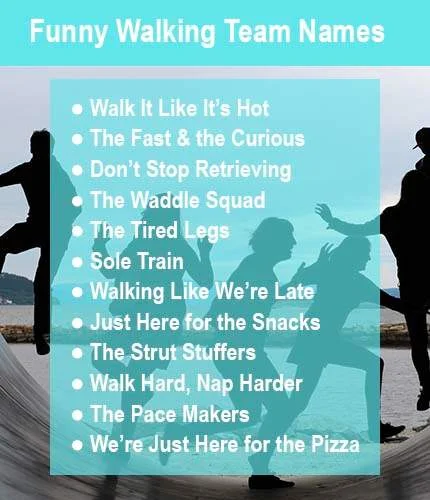
Donors who smile at the name are already emotionally warmed up before they read the ask. The critical constraint is that the pun must contain an unambiguous cause signal; a pun that is only funny, with no cause reference, misses the conversion opportunity entirely. Test the name by asking whether a stranger could identify the cause from the name alone.
8. Team [Last Name] Strong – Family-Unit Charity Walk Names That Maximize Donor Network Reach
Family-surname team names activate the most concentrated peer network available in peer-to-peer fundraising: the extended family. Cousins, neighbors, and family friends who receive a donation ask from “Team Ramirez Strong” understand immediately who is walking and why the cause matters to that family. The tradeoff is reach ceiling: a family-unit name has a smaller natural donor pool than a cause-forward name that can attract strangers browsing the leaderboard.
9. Walkers With a Mission – Charity Walk Names That Double as a Fundraising Call to Action
Names that embed an active verb or a mission statement do quiet persuasion work every time they appear in a leaderboard, email, or social share. “Walkers With a Mission” tells a donor that this team has a specific purpose, which triggers curiosity about what that purpose is. The format is most effective when the team page delivers on the implied promise with a clear, specific fundraising goal stated in the first two sentences of the team description.
10. Color-Coded Cause Names – Pink Warriors, Blue Ribbon Brigade, and the Power of Cause Colors in Team Names
Cause colors carry decades of cultural shorthand: pink for breast cancer, red for heart disease, gold for childhood cancer. A team name that uses the correct cause color signals organizational literacy to donors, which builds credibility before a single word of the team story is read. The limitation is saturation: at large events, every third team may be using the same color word, which erodes the distinctiveness advantage. Pair the color with a specific, unexpected second word to cut through.
11. The ‘In Memory of’ Prefix – Why Grief-Forward Charity Walk Names Outperform Generic Constructions
Grief-forward names create an immediate emotional contract with the donor: someone loved this person, and your donation honors that love. CharityEngine’s research notes that team names carrying personal meaning signal authenticity and motivate participants’ contacts to donate more readily than generic cause labels. The honest tradeoff is that grief-forward names can feel heavy in a walk environment that also has music, costumes, and competitive energy; balance the name with a warm or spirited team description to hold both registers.
12. Stride for Pride – LGBTQ+ Cause Walk Names That Signal Community and Attract Ally Donors
Community-identity names do two jobs simultaneously: they signal belonging to in-group donors who want to support their own community, and they signal allyship opportunity to out-group donors who want to demonstrate solidarity. “Stride for Pride” accomplishes both in three words. The format is most effective at events that already have a visible LGBTQ+ presence; at events where the community is less represented, a more explicit cause reference in the team description helps donors understand the specific organization benefiting from their gift.
13. Milestone-Named Teams – Using Fundraising Goals Inside the Team Name to Drive Competitive Giving
Embedding a fundraising target directly in the team name (“$5K Strikers” or “The Thousand Dollar Walkers”) turns the name itself into a public commitment. Donors who see a specific goal are more likely to give because the target creates a completion narrative: their donation moves the team closer to a stated finish line. This format works best on platforms that display team fundraising progress visibly next to the team name, so the goal and the progress bar appear together in the donor’s field of view.
14. Occupation-Based Cause Walk Names – Nurses Who Walk, Teachers Who Trek, and the Power of Professional Identity
Professional-identity names activate occupational solidarity networks that personal-network names cannot reach. A team called “Nurses Who Walk for Hearts” can recruit colleagues from across a hospital system who have no personal connection to the organizing team member but share a professional identity. The limitation is that occupation-based names work best when the profession has a clear, recognized connection to the cause; a loose professional-cause pairing can feel arbitrary and fail to convert either audience.
15. Alliterative Cause Names – Beating Cancer Bunch, Diabetes Dashers, and Why Sound Patterns Aid Donor Recall
Alliteration is a memory tool, not a stylistic flourish. When a donor hears “Diabetes Dashers” once and then sees it again on a leaderboard three days later, the sound pattern triggers recognition faster than a non-alliterative name would. That recall advantage compounds in peer-to-peer fundraising because donors often receive multiple touchpoints before they give. The tradeoff is that forced alliteration can produce awkward constructions that sacrifice cause clarity for sound; if the cause signal weakens, the name loses its functional purpose.
Most charity walk organizers assume that outfitting a color-coded cause team in matching shirts requires a bulk minimum order that prices small groups out before the event even starts. The real cost of that assumption is showing up on event day with a great name and no visual identity to back it up. ooShirts removes that barrier with any-quantity ordering and all-inclusive pricing, so a five-person “Pink Warriors” team can close the loop between the name they chose and the shirts their donors will actually see at the finish line.
Charity and cause walks are one slice of the walking team universe. If your team is a work crew, a dog-walking club, a school squad, or just a group of friends who want a name that fits their specific vibe, the next section has a category for every flavor left on your list.
Walking Team Names by Category for Every Vibe Left on Your List
Work crews, dog-walking clubs, school squads, and friend groups each carry a different energy, and a name that fits the wrong register lands like a joke at the wrong moment. The creative walking team names below are sorted by the job they actually do, so you can match the name to your group’s identity before the event banner gets printed.
1. Sole Searchers – Creative Walking Team Name for Groups Who Want to Stand Out
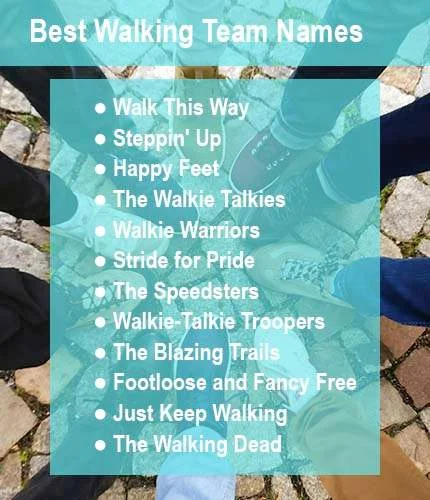
Sole Searchers works best for a mixed-age group that wants a name with personality but no inside joke attached. The wordplay is immediate, the reference is universal, and it reads cleanly on a bib or shirt. The one limitation: it skews slightly playful, so if your group is aiming for a polished corporate wellness image, it may read as too casual for that context.
2. Pavement Pioneers – Creative Name for Groups Who Want a Bold, Trailblazing Identity
Pavement Pioneers carries a sense of forward motion without leaning on clichés about steps or miles. It works especially well for neighborhood groups launching a new walking program, where the name signals that this is the founding cohort. The tradeoff is that “pioneers” can feel slightly grandiose for a low-key social walk, so read your group’s energy before committing.
3. Kinetic Collective – Creative Walking Team Name with an Urban, Modern Edge
Kinetic Collective fits corporate wellness walking challenges where the name needs to sound intentional rather than improvised. Research on event fundraising psychology consistently finds that participants who feel a strong team identity are more likely to stay engaged and recruit others, and a name like this signals that the team was built with purpose. The limitation: it is abstract enough that newcomers may not immediately grasp the group’s spirit.
4. Miles of Momentum – Motivational Walking Team Name for Personal Health Milestones
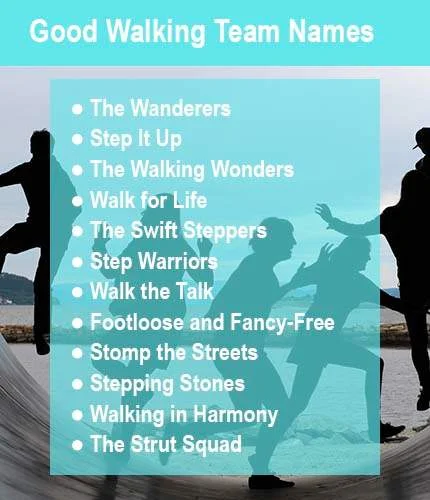
Miles of Momentum is built for groups organized around a personal health goal, a recovery milestone, or a fitness challenge with a measurable endpoint. The name does double duty as a team motto without needing a separate tagline. It is less effective for social or dog-walking groups where the tone needs warmth over drive.
5. Step by Strength – Motivational Name for Fitness-Focused Walking Teams
Step by Strength is the right pick when the group’s shared story is overcoming something physical: a health scare, a rehabilitation journey, or a return to activity after a long break. Walkers who identify with a name reflecting their values are generally more likely to stay committed to health milestones tied to the event. Avoid it if your group is purely recreational; the gravitas can feel mismatched.
6. Forward & Fierce – Motivational Walking Team Name for Groups Reclaiming Their Health
Forward & Fierce is the most emotionally charged option in this category, which makes it powerful for survivor groups or teams walking in honor of someone. That same intensity is its limitation: it can feel too heavy for a lighthearted neighborhood stroll or a company step challenge where the goal is fun participation over personal triumph.
7. Paws & Strides – Dog Walking Team Name for Pet-Friendly Community Walk Events
Paws & Strides is the clearest signal to other participants that dogs are part of the team. Pet-friendly 5K and charity walk events have grown into a recognized event category across the US, and an organizer who names the team to reflect that gives every dog owner in the group an immediate reason to feel included. The name is warm without being silly.
8. The Leash League – Dog Walking Team Name with a Playful Community Sports Feel
The Leash League borrows the energy of a recreational sports team, which makes it ideal for a recurring dog walk group rather than a one-off charity event. The sports-team framing also makes it easier to build ongoing identity around: matching bandanas, group shirts, a recurring route. The tradeoff is that it reads as lighthearted, so it is not the right fit if the event has a serious fundraising or memorial tone.
9. Waggers & Walkers – Dog Walking Team Name That Centers the Dogs as Co-Stars
Waggers & Walkers is the warmest option in this sub-category, and it works best when the dogs are the draw. If your group formed because of a shared love of a specific breed or a dog park community, this name reflects that origin story directly. It is the least versatile of the three dog walking names for events where the cause, not the pets, is the primary focus.
10. Block Party Striders – Cool, Punchy Name for Mixed-Age Neighborhood Walking Groups
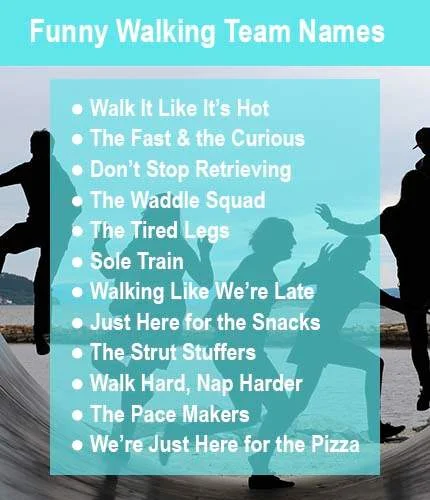
Block Party Striders anchors the team in a specific geography without requiring any inside knowledge to understand. It signals community, accessibility, and a low barrier to joining, which matters when you are recruiting neighbors across age groups. The limitation is that it may feel too local for a regional charity event where the team needs to resonate with a broader audience.
11. The Stride Tribe – Cool, Punchy Walking Team Name for Community Groups of Any Age
The Stride Tribe is the most scalable name in this category. It works for a small neighborhood group, a company wellness team, or a recurring community walking club because “tribe” implies belonging without requiring a shared backstory. Once your group lands on a name like this, the next practical step is shirts, and ooShirts lets you order exactly the number your group needs with no minimum, all-inclusive pricing, and free shipping on standard delivery within the contiguous US.
12. Urban Pacers – Cool, Minimal Walking Team Name for City-Based Community Groups
Urban Pacers is the most stripped-down option on this list, and that restraint is its strength for city-based groups that want a name that looks sharp on a shirt without explaining itself. It is not the right fit for suburban or rural groups where “urban” reads as geographically inaccurate, and it lacks the warmth of the other community names if your group’s identity is built around connection rather than movement.
Once You Have the Name, Get the Shirts Without the Headache
Once a team name is locked, the single biggest execution risk is the hidden all-in cost and minimum-quantity trap that forces small groups to over-order or overpay.
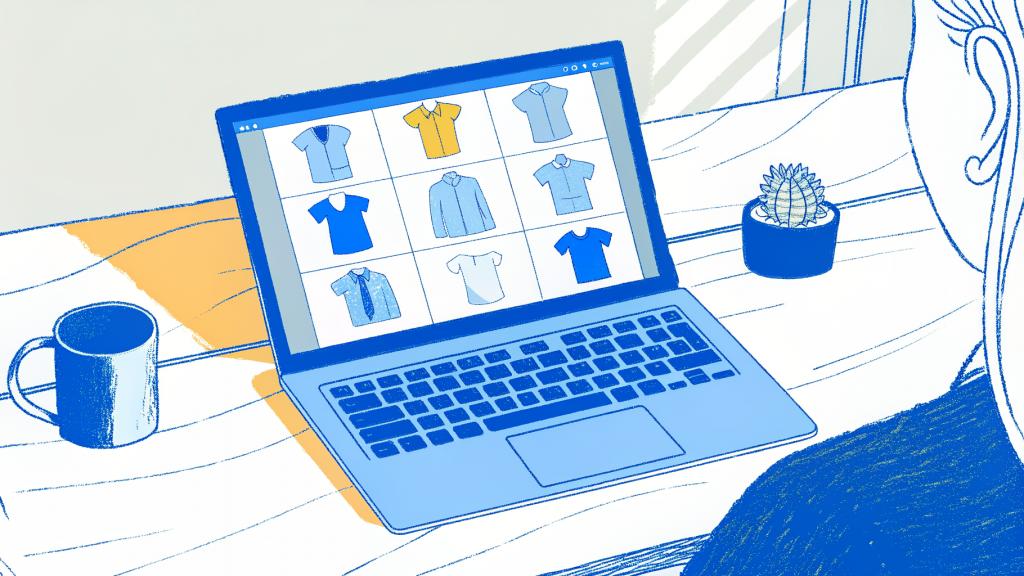
For a 7-person charity walk team, that means either padding the order with shirts nobody needs or abandoning the idea entirely.
Pros and cons at a glance
| ✓ Pros | ✗ Cons |
| Eliminates traditional minimum order requirements for small groups | DTG per-shirt costs run higher than bulk screen printing on large orders |
| Allows teams to order exactly the count their roster demands | Not the better value if your team has 80 people |
| Transparent, all-inclusive pricing, no hidden setup or screen fees | , |
| Free shipping removes last-minute budget surprises | , |
Worth naming honestly: DTG per-shirt costs run higher than bulk screen printing on large orders. If your team has 80 people, screen printing at volume is likely the better value.
How All-Inclusive Pricing and Free Shipping Remove Last-Minute Budget Stress
The real price trap is setup fees, screen charges, and shipping added at checkout, which routinely push the true total well above the advertised rate. Print-on-demand platforms enable organizers to order exactly the units needed, removing the bulk-order barrier that inflates total landed cost for small groups, according to industry data et al. in the International Journal of Retail and Distribution Management (2026). Transparent, all-inclusive pricing means the number you see before you click is the number you pay. Guaranteed delivery dates matter as much as price; custom shirts ordered without a confirmed arrival window are a gamble no organizer should take.
How to Go From a Locked Team Name to Matching Shirts in One Step
One efficient path from a locked team name to matching shirts is a printer that handles any quantity, shows the full price upfront, ships free, and confirms a delivery date before checkout. ooShirts carries no minimum order for DTG printing, so a team of 4 or 40 orders exactly what it needs for cheap custom t-shirt printing, without negotiating or over-ordering to justify the run. Pricing is all-inclusive and free shipping is standard, so the total shown at checkout is the total paid.
If your team is large, traditional bulk screen printing will likely cost less per shirt than DTG, so ooShirts is the stronger fit for small-to-mid-size groups rather than high-volume orders where bulk pricing wins on unit cost.
Next steps
If your group is still debating names the day before the event, the bottleneck is not the list. The path forward starts with locking your vibe and goal before you evaluate a single option, because the organizer who knows what their group needs picks a name in minutes while everyone else is still scrolling. Start with our cheap custom t-shirt printing.
The insight that humor earns its place by being inclusive across people with no shared background means your name does active cohesion work before anyone arrives at the start line. The insight that a charity walk team name acts as a micro-marketing asset, lowering the donation barrier for unfamiliar donors, means the name is not decoration but your first conversion tool. Together, they point to one practical action: choose the name with intention, then make it visible on every shirt in the group.
Start with ooShirts for cheap custom t-shirt printing. Order exactly the count your roster needs, no minimums, with all-inclusive pricing and a guaranteed delivery date, so the name your team spent real energy choosing shows up on every chest at the finish line.
Frequently Asked Questions
How do I know if our team name is too long for a race bib?
Most race bib fields cap team names at roughly 20 to 25 characters, so use that as your hard limit when evaluating finalists. The post also recommends a quick gut-check: if you can’t say it out loud without spelling it, an announcer will likely mangle it at the start line.
We’re doing a charity walk, should our team name mention the cause?
Yes, for fundraising walks a cause-embedded name consistently outperforms clever wordplay on crowded donor leaderboards. A name like ‘Stride for Sarah’ tells every potential donor exactly who the walk is for and why it matters, doing work in conversations the name should have started on its own.
Why do funny team names actually work, and aren’t they too casual for a serious walk?
Humor is a deliberate identity move, not a lazy fallback, teams that incorporate humor into their culture report up to 31% higher productivity than those that don’t. Walking puns like ‘Sole Survivors’ work especially well because they cost nothing to decode across age groups, making them unifying rather than merely amusing.
Our group can’t agree on a name, what’s the fastest way to break the deadlock?
Lock in your vibe before you look at a single name option. Ask one question first: what do you want people to feel when your team name is called at the start line, funny, motivational, cause-proud, or creative? That single answer eliminates the vast majority of any list before a vote even starts, turning what feels like a debate into an obvious final choice.
What if our headcount changes after we’ve already ordered team shirts?
It’s a common problem, teammates drop out or join last minute. Because ooShirts has no minimum order requirement for direct-to-garment printing, a group of any size can order exactly the shirts they need, and customer support is available seven days a week to adjust an order over the phone if your count shifts late in the process.
Leave a Reply