
Hidden fees at checkout are the real reason sellers flee Threadless. Here is how to find a platform where the price you see before you design is the price on your invoice.
Most people assume sellers search for Threadless alternatives because a competing platform offers a better design tool or a wider product catalog. The dominant reason sellers and buyers leave Threadless in 2026 is simpler and more painful: they don’t find out what they actually owe until the final checkout screen. A group organizer budgets $12 per shirt based on the advertised base price, then watches the real per-unit cost climb past $18 after setup charges, per-color fees, and shipping stack on top. By then, they’ve already spent an hour building the order. See our cheap custom t-shirt printing solutions for how this works in practice.
The gap between the listed price and the checkout total isn’t a rounding error. Setup fees, per-color charges, and shipping costs get added late in the process, after you’ve already committed time and creative energy. According to the Printful Blog’s Print on Demand Statistics (2024), 24% of consumers have abandoned an online purchase specifically because of unexpected costs discovered at checkout. That’s nearly one in four buyers walking away after the platform already had their attention.

24% of buyers abandon carts over hidden fees
Print-on-demand sellers most commonly cite margin erosion from base price markups, per-item fees, and shipping costs as the leading reason they switch platforms. For a group organizer ordering 30 shirts for a club event, a per-color screen charge applied to each color in a two-color logo can quietly erase any savings the advertised base price suggested. Free setup and free shipping, built into the quoted price from the start, change that math entirely. Platforms like ooShirts include both in their live quote, so the number you see before you start designing is the number on your invoice, a structural difference from platforms where setup and shipping stack on at checkout. (See the comparison section below for a full side-by-side of transparent-pricing platforms.)
Key takeaways
- The dominant reason sellers leave Threadless in 2026 is a final checkout screen that reveals fees they never saw coming.
- Threadless alternatives split into three distinct models: passive marketplaces that trade margin for traffic, branded storefronts that hand you control, and fulfillment-only backends that require you to bring your own audience.
- Marketplace platforms like Redbubble pull millions of monthly visitors, but the royalty structure means you surrender margin control in exchange for that traffic, a trade many sellers regret after their first payout.
- Branded-storefront platforms (Fourthwall, Spring, Spreadshop) offer genuine brand ownership, but margin clarity at publish time varies sharply across all three.
- Fulfillment-only platforms like Printify and Printful handle production and shipping; they do not find buyers, and the cost stack only becomes visible after you connect a storefront and run the full math.
- For group and event orders, fee layers, base cost, shipping, platform cut, import duties, routinely stack in ways that only surface at checkout or after the first customer complaint.
- ooShirts closes that gap with live quotes that show the exact price, shirt, printing, and shipping included, before you commit, so the number you see at the start is the number you pay at the end.
The Three Models of Threadless Alternatives, and the One Most Buyers Confuse
Most buyers shopping for Threadless alternatives treat the decision as a feature comparison, stacking up product catalogs and integrations until one platform wins on points. That approach skips the question that actually determines whether a platform works for you: which underlying business model fits how you sell, who you’re selling to, and how those buyers find you. The models covered here operate on fundamentally different logic, and mistaking one for another is how sellers end up locked into margin structures or traffic problems they didn’t see coming.

Passive Marketplace Alternatives
The margin squeeze is real. Sellers who’ve spent months building a catalog on a passive marketplace often discover that a single algorithm change or platform fee adjustment wipes out their earnings overnight. You don’t own the audience. You’re renting access to it. Passive marketplace sellers trade margin control for discovery, a bargain that compounds painfully when platform economics shift beneath you.
Branded Storefront Threadless Alternatives
The branded storefront model hands you a customizable shop and puts you in charge of pricing, customer relationships, and brand identity. That control comes at a cost: traffic is your problem, not the platform’s. This is a fundamentally different business model from passive marketplaces, not just a different feature set.
This model rewards creators who already have an audience or a marketing budget. Without either, the storefront sits empty.
Fulfillment-Only Threadless Alternatives
Fulfillment-only services sit beneath the storefront layer. They print and ship; you handle everything else. They’re legitimate and widely adopted, but signing up for one without a store, a traffic strategy, and a customer base is like leasing warehouse space before you have inventory to fill it. As Merch Titans notes in its breakdown of fulfillment-centric platforms, the operational burden on the seller is substantial. Fulfillment solves the production problem, not the demand problem.
Group-Fulfillment Threadless Alternatives
A distinct, often-overlooked segment exists: bulk fulfillment for organized groups, including:
- sports teams
- clubs
- churches
- family reunions
These buyers don’t want marketplace discovery or brand building. They want consistent color across every size, a price that works for a fixed budget, and a vendor who will actually pick up the phone when headcount shifts at the last minute, because it always does.
That last point is where budget printers typically lose first-time group buyers to premium options like Custom Ink. The fear isn’t the price; it’s the silence. What happens when the order needs to change three days before the event?
Jessie Creighton of Gorham, Maine ran directly into this problem. She organized custom shirts for a surprise birthday party for her grandmother, a one-shot event with a fixed, unmovable date. She had no procurement experience and no margin for error.
Her order involved custom requests that couldn’t be resolved through the online design tool alone, so the ooShirts team worked through them with her by phone. Then, midway through the process, her headcount shifted, the way it always does when you’re collecting names across a family. Rather than forcing her to restart, the team absorbed the size change and rushed the order so it arrived before the party.
She rated both print quality and service 5 out of 5 and described the team as going above and beyond, specifically calling out the phone support and the willingness to accommodate the late count change.
Her experience maps precisely onto the three failure modes that kill group orders: changing requirements, a moving headcount, and a shrinking timeline. ooShirts held on all three, and the low price is what got her in the door, but a person on the phone rerunning the order is what made the party happen.
That’s the operational reality that most group-order comparisons ignore. ooShirts backs its pricing with customer support seven days a week, guaranteed delivery dates, all-inclusive transparent pricing with no hidden fees, and a price match guarantee for buyers comparing options before committing. For a first-time organizer spending on behalf of a group, those aren’t marketing bullets, they’re the difference between a successful event and an empty table. Whether the order is shirts for a family reunion, onboarding kits that make new hires feel welcomed and culturally aligned from day one, or custom apparel for a one-time celebration, the underlying requirement is the same: someone needs to be reachable, and the order needs to arrive.
Best Threadless Alternatives for Passive Income – Marketplaces with Built-In Traffic
Traffic numbers make a seductive promise: upload your designs once, let 17 million monthly visitors do the rest, and watch royalties accumulate while you sleep. The reality sellers discover after their first payout is more complicated. According to SimilarWeb, Redbubble does pull roughly 17 million monthly visitors, making it one of the largest passive-income POD marketplaces on the internet.
Semrush corroborates that scale, placing Redbubble firmly among the highest-traffic print-on-demand destinations online. But raw traffic is only half the equation. The half that determines your take-home is how much of each sale the platform keeps before the money reaches you, and several high-traffic marketplaces bury royalty tiers, demotion penalties, and payout inconsistencies deep in their terms.
Choosing a passive-income marketplace is about understanding which platform’s margin math works in your favor once the platform takes its cut. A graphic artist uploading the same design to two different marketplaces simultaneously will often find the smaller platform pays out more per sale, because its royalty structure is cleaner. That gap compounds fast across hundreds of designs.
There is also a structural reality most sellers only recognize after they have been on a platform for a year or two. Every sale a marketplace processes on your behalf builds the platform’s customer database, not yours. The buyer who purchases your design on Redbubble becomes Redbubble’s customer. You get a royalty. They get the relationship, the email address, and the repeat purchase. Your passive income is, in a real sense, an active subsidy of the marketplace’s brand equity at the expense of your own.
Every sale a marketplace processes on your behalf builds the platform’s customer database, not yours.
Beyond margin math, there is an operational reality that stings beginners especially hard: big POD platforms routinely suffer from shipping delays, high base costs, and support teams that are difficult to reach when something goes wrong. When an order arrives late, or the per-unit cost quietly erodes the royalty you thought you were earning, there is often no one available to help you fix it quickly. That combination of unreliable fulfillment and opaque pricing is what pushes sellers to seek alternatives built around reliability and cost transparency rather than raw audience size.
That trade-off is worth making for the right seller in the right situation. Here is how each major option stacks up when you look past the traffic numbers and into the margin math.
1. ooShirts – Best for Budget-Conscious Groups Wanting Transparent Pricing
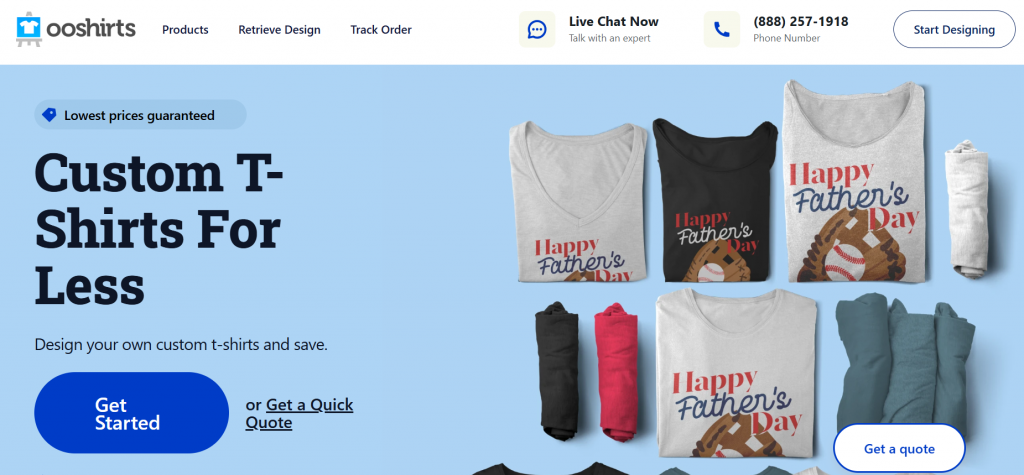
If your goal is getting a specific number of shirts printed for an event, team, or onboarding kit at a price you can confirm before you commit, ooShirts solves a fundamentally different problem than any marketplace here. Live, all-inclusive quotes show the exact cost per shirt, printing, setup, and shipping included, with no hidden fees surfacing at checkout. That matters most when you are comparing prices before placing an order and need the number on screen to be the number you actually pay.
For organizations building branded company swag and onboarding kits that make new hires feel welcomed and culturally aligned from day one, ooShirts removes the two friction points that derail most group orders: unpredictable cost and uncertain delivery. Guaranteed delivery dates mean you can plan an onboarding date around your shirt order rather than hoping fulfillment comes through in time. A price match guarantee means you are not leaving money on the table if you find a lower published rate elsewhere. Free shipping and setup eliminate the line items that inflate competitors’ checkout totals after the initial quote looks attractive.
The catalog spans 100-plus shirt styles, covering everything from lightweight event tees to premium fleece suitable for a branded welcome kit. Screen printing services handle bulk runs efficiently, while no minimum orders on DTG printing means a small pilot batch, say, a five-person new-hire class, is just as viable as a company-wide rollout. A quality guarantee backs every order, and customer support available seven days a week means questions about artwork, sizing, or delivery get answered during the window that actually matters, not after the event has passed.
Most beneficial when you have a fixed headcount, a firm budget, and zero tolerance for checkout surprises, and equally well-suited when speed and support reliability matter as much as unit price.
2. Redbubble – Best Marketplace for Artists Wanting Broad Product Range
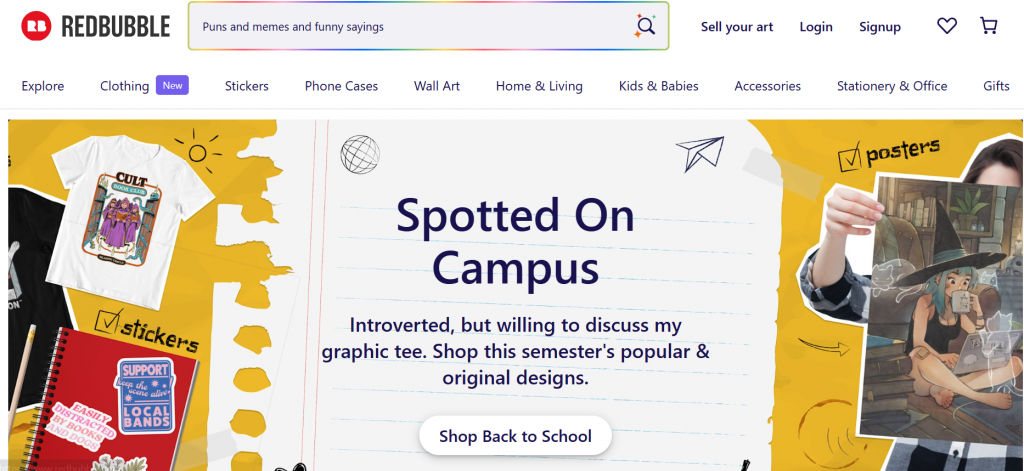
Redbubble is the largest print-on-demand marketplace with massive built-in audience reach, confirmed at approximately 17 million monthly visitors by SimilarWeb and independently tracked by Semrush. Artists can list designs across 70-plus product types without managing fulfillment or customer service. The real tradeoff is margin control: Redbubble sets the base price and takes a significant cut, leaving sellers with a royalty percentage on top of a base they cannot adjust. High volume can compensate, but thin per-unit margins mean the math only works if your designs rank well organically.
3. TeePublic – Best for Upload-and-Forget Passive Income with Zero Customer Service
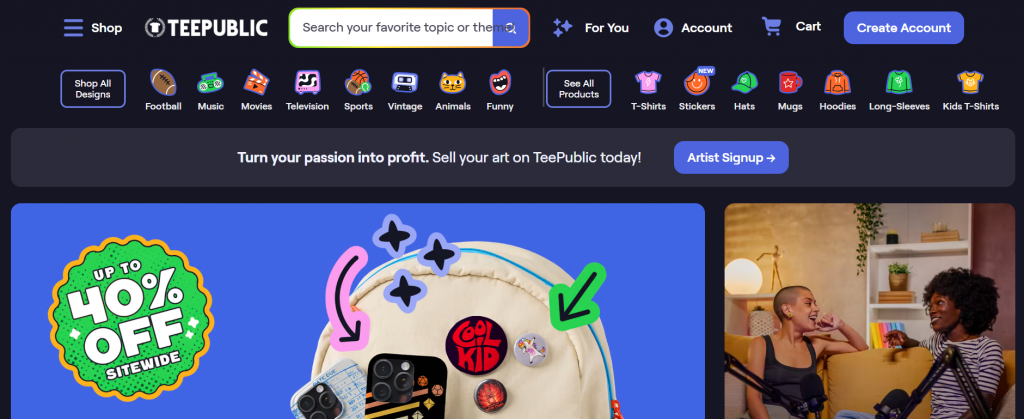
TeePublic, now owned by Redbubble, is the simplest upload-and-forget option on this list, with strong organic search visibility for graphic tees and a straightforward royalty structure. Creator reports from 2024 and 2025 place typical monthly earnings in the range of $25 to $160 for mid-catalog sellers, which sets realistic expectations. The limitation is the platform’s Apprentice demotion system: accounts flagged for low sales velocity can be downgraded, reducing visibility further and creating a difficult recovery cycle for new sellers still building their catalog.
4. Zazzle – Best for Customizable Stationery and Niche Product Designers
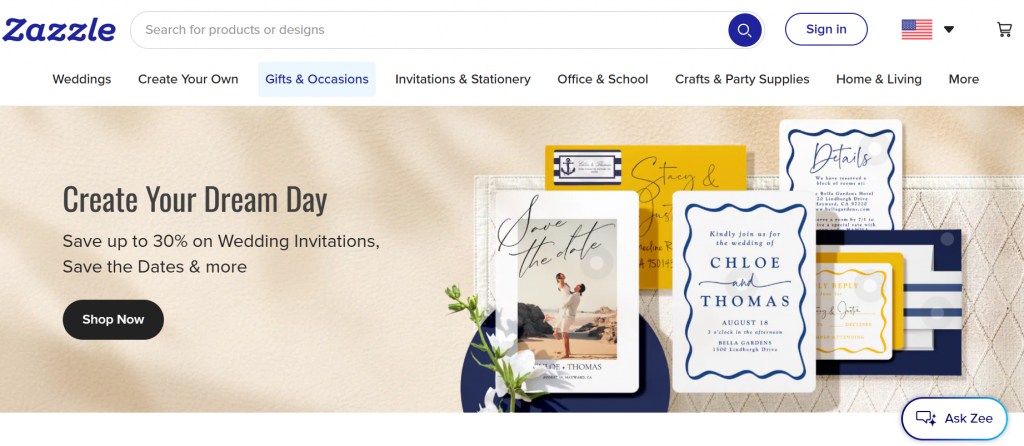
Zazzle allows sellers to set their own royalty percentage on top of the base product price, which gives more margin control than Redbubble or TeePublic. The product catalog skews toward stationery, wedding goods, and niche customizable items rather than apparel. A risk some sellers report is payout discrepancies: royalty calculations that do not always reconcile cleanly with expected earnings, which makes income forecasting harder than the platform’s flexibility would suggest.
5. Society6 – Best for Fine Art and Home Décor Designers Targeting Premium Buyers

Society6 is built around fine art, home decor, wall prints, and furniture rather than graphic tees. Artist margin percentages on apparel run thin, while home decor and wall art categories carry stronger per-unit returns. The audience skews toward buyers willing to pay more for design-forward products, which rewards artists with a distinct aesthetic over generalist graphic designers.
6. Merch by Amazon – Best for Tapping Amazon’s Search Traffic at Scale
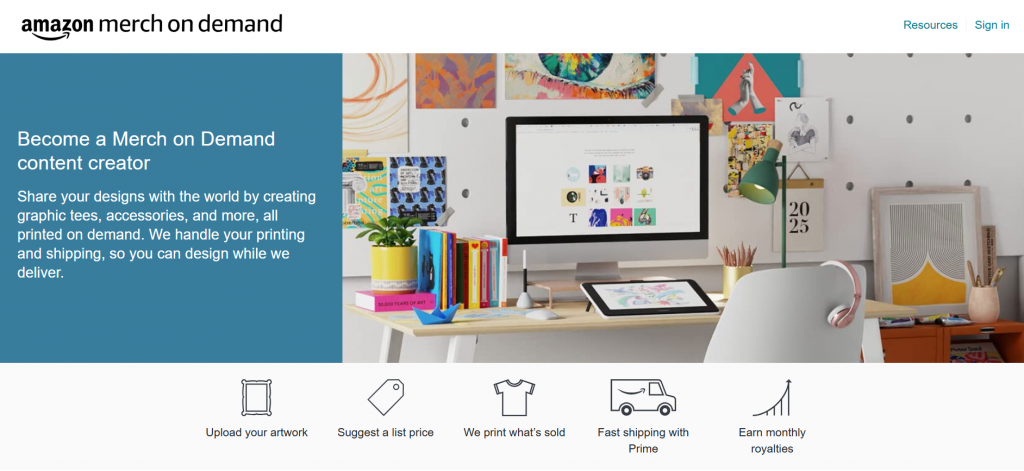
Amazon Merch on Demand requires application and approval, and new sellers start with a severely limited design slot count that expands only as sales accumulate. Once tiered up, the organic reach through Amazon’s search engine is unmatched by any other marketplace on this list. The royalty rate varies by product price tier, so higher-priced listings return meaningfully more per sale than entry-level tees.
7. Etsy Print-on-Demand Integration – Best for Sellers Who Want Higher Margins with Marketplace Support
Etsy paired with a POD fulfillment partner like Printify or Printful gives sellers far better profit margins than pure marketplaces like TeePublic, while still benefiting from Etsy’s established search traffic and buyer trust. Sellers often describe Etsy as the stronger revenue option for designers willing to handle basic shop management. The tradeoff is operational overhead: sellers must manage listings, customer messages, and occasional disputes, making it less passive than pure POD platforms.
Best Threadless Alternatives for Creators Who Want Their Own Brand and Storefront
Picking a branded-storefront platform because it has the longest feature list is how creators end up staring at a payout that looks nothing like the margin they planned. The real question is simpler and sharper: does the platform show you the complete cost before you publish, or does the math only surface after your first sale lands?
“Platform fees and marketplace commissions compress margins, making it harder to profit when relying solely on third-party marketplaces rather than my own branded storefront.”
Fourthwall, Spring, and Spreadshop all give creators genuine brand ownership: full control over branding, customer data, and pricing in ways marketplace-based platforms cannot match. But they differ sharply on pricing transparency, and that gap is where margins quietly disappear. That pressure is real: major POD marketplaces have significantly cut artist payout rates in recent years, leaving creators earning a fraction of what the same catalog generated before, and compressing margins further when platform fees and commissions stack on top. The shift toward owned storefronts and purpose-built print partners is a direct response to that structural squeeze.
1. ooShirts – Best for Budget-Conscious Creators Who Want Full Brand Ownership
Cheap custom t-shirt printing done right means seeing the full per-shirt cost, including printing and free standard shipping to the contiguous US, before a single order is placed. ooShirts delivers this with live, all-inclusive transparent pricing and no hidden setup fees or per-color charges, so the number you see when comparing prices is the number you pay. As the Arklavo Custom Apparel Guide (2026) documents, per-color fees and checkout-stage shipping additions are a recurring structural problem across custom apparel platforms; the all-inclusive quote model addresses that problem at the exact point where most organizers encounter it, during the price-comparison window, before commitment.
Beyond price clarity, ooShirts brings a set of operational facts that matter when the order has a hard deadline or a skeptical buyer who has been burned by slow fulfillment before: fast turnaround times, guaranteed delivery dates, and customer support available seven days a week. For groups sourcing consistent, repeatable uniform or branded merchandise orders, say, a company scaling branded shirts across departments or office locations, the price match guarantee and screen printing services mean you are not re-negotiating from scratch on every reorder. And with 100+ shirt styles and no minimum orders for DTG printing, the catalog is wide enough to get shirts a team will actually want to wear rather than tolerate. The quality guarantee closes the loop: if the print does not meet the standard, ooShirts stands behind it.
The honest trade-off: this model suits creators and organizations ordering for a defined group or event rather than running an open-ended, always-on storefront selling to strangers. If your goal is a persistent shop with continuous drop-ship fulfillment, the integrations in the next section are a better fit.
2. Printful – Best for Creators Who Want Automated Branding and Global Fulfillment
Printful’s in-house production means consistent print quality and white-label options like custom neck labels, which matter most when brand perception is non-negotiable. The real trade-off is cost: Printful’s base prices run higher than network-based competitors, which compresses margins for creators in competitive niches, a meaningful concern given how much marketplace fee structures have already eroded creator income across the industry. Most beneficial when your audience will pay a premium and a single inconsistent order would do lasting brand damage. If you are margin-sensitive and willing to vet print partners yourself, the next option fits better.
3. Printify – Best for Creators Who Want to Shop Print Partners for the Best Price-Quality Balance
Printify’s global print-provider network gives creators the ability to compare base costs across suppliers for the same product, which is the most direct lever for protecting margin on a branded storefront. The trade-off is variability: quality and fulfillment speed depend on the provider you select, so sample orders before going live are not optional, they are essential. Most beneficial for creators who have time to test and are building a storefront on Shopify or Etsy where provider-switching is low-friction.
4. Gelato – Best for Artists and Creators Selling Wall Art or Prints to a Global Audience
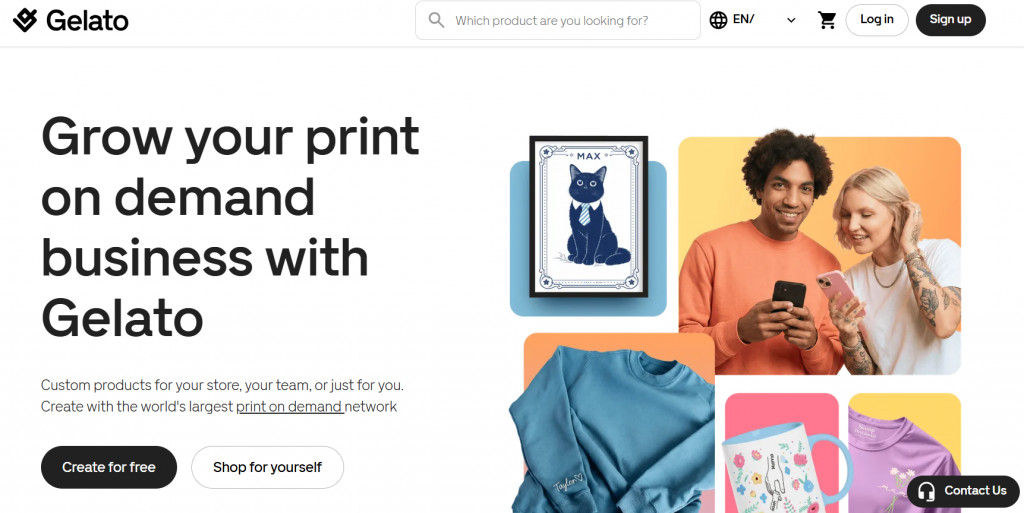
Gelato routes each order to a local print hub rather than shipping from a single warehouse, which meaningfully cuts cross-border delivery times for international buyers. It operates print hubs across more than 32 countries, reducing average shipping distances and customs friction for creators with global audiences. The limitation is product range: Gelato shines on wall art, photo prints, and stationery, but it is not the right fit for a creator whose catalog is primarily apparel.
Related Reading
- Best Printer For T-shirt Printing
- Spreadshirt Alternative
- Gooten Alternative
- Gotprint Vs Vistaprint
- Print Aura Alternatives
Best Threadless Alternatives for Fulfillment-Only Integration – Printify vs. Printful and Beyond
Printify and Printful are both fulfillment-only platforms. Neither operates a consumer marketplace. According to Printify’s platform documentation, sellers connect their own Shopify or Etsy store, then route orders through the platform for production and shipping. The platform handles fulfillment; you supply the audience. That model works well for sellers who already own a store and want to add product lines without holding inventory.
The difference between the two is where the cost risk lives.
Printify routes orders through a global network of independent print providers. Sellers can select providers to optimize for price, location, or product quality, and base costs vary by provider rather than following a uniform rate. A base cost of roughly $8 per shirt sounds attractive against Printful’s roughly $12 per shirt, but that lower figure is not a fixed structure.
It is a range that shifts depending on which provider fulfills the order. A pattern that anyone who has placed serious volume through these platforms will recognize: a provider switch, a fulfillment reroute during a stockout, or a batch from a different facility produces color saturation that does not match the approved sample. The advertised margin advantage quietly disappears, and the seller absorbs the reorder cost.
Slow shipping times, high effective costs, and support teams that are hard to reach when something goes wrong compound the problem. For a first-time buyer or a group organizer with a hard deadline, those are not hypothetical risks. They are the reasons orders fail.
Printful operates its own production facilities, which means the base cost is higher and the output is more predictable. Sellers who have switched after a batch of inconsistent prints typically describe the move as paying a fixed premium to eliminate a variable they could not control. For a seller building a brand on repeat customers, that tradeoff is rational.
The hidden problem neither platform fully solves is total landed cost visibility. Both show production costs clearly enough, but the real per-shirt number, including printing and shipping, does not fully surface until you are mid-checkout. For a group organizer trying to lock in a budget for 48 matching shirts before an event, that creates exactly the sticker-shock moment they were trying to avoid.
That gap is where all-inclusive, transparent pricing changes the decision entirely. ooShirts publishes the shirt price, printing, and free standard shipping from the first quote, no checkout-moment recalculation, no surprise on the back end. The price match guarantee and guaranteed delivery dates mean the number a buyer sees at the start of the process is the number that holds through to delivery.
What that looks like in practice: Jessie Creighton of Gorham, Maine, organized custom shirts for her grandmother’s surprise birthday party, a one-shot event with a fixed, unmovable date and a headcount that kept shifting as she collected names from family members. She had no procurement experience, no prior print orders, and several custom requests the design tool alone couldn’t handle. The ooShirts team worked through those requests with her on the phone.
When her order count changed late in the process, they adjusted the order and rushed it so it would arrive before the party. She rated print quality and service 5/5 and specifically called out the phone support and the team’s willingness to absorb the late size change. The order delivered on time.
That is Printify’s model operating at its limit: self-serve support and a fixed provider queue are not built to catch a moving headcount, and it is the exact scenario where ooShirts’ 7-days-a-week customer support and no-minimum DTG printing turn a potential failure into a party that actually happens.
The trust objection that sends first-time buyers toward more expensive alternatives usually comes down to one fear: that a lower price means no one picks up the phone. Jessie’s order is the direct answer to that objection.
Printify and Printful solve the fulfillment puzzle for sellers who already own a store, but they are built for the solo entrepreneur running a Shopify backend, not for the event coordinator who needs 48 matching shirts by Friday with a locked-in total. That is a different problem entirely, and the next section covers the one model purpose-built to solve it.
1. ooShirts – Best Threadless Alternative for Budget-First Bulk Apparel Orders
ooShirts is the go-to pick for groups, teams, and small businesses that need affordable custom t-shirts without hidden fees eating into margins. Its lowest-price guarantee with price matching and all-inclusive transparent pricing make cost forecasting straightforward, a real advantage over Threadless’s marketplace model. The tradeoff: ooShirts focuses on direct custom orders rather than automated storefront fulfillment integrations, so it suits bulk buyers more than hands-off dropshippers.
2. Printful – Best Threadless Alternative for Brand-Controlled Fulfillment-Only Integration
Printful owns its production facilities, giving sellers tighter quality control and consistent output, a meaningful edge over Threadless’s artist-marketplace model when brand reputation is on the line. It integrates directly with Shopify, Etsy, and other platforms for fully automated fulfillment with no inventory required. The key tradeoff is higher base product costs compared to marketplace alternatives, which compresses margins for sellers competing on price rather than brand differentiation.
3. Printify – Best Threadless Alternative for Lowest Per-Unit POD Costs via Print Network
Printify operates as a print network aggregator, connecting sellers to over 90 third-party print providers across multiple countries, making it the strongest Threadless alternative when minimizing per-unit production cost is the priority. Sellers can shop providers by price and location, unlocking margins Threadless’s fixed royalty structure can’t match. The real tradeoff is quality variability: since Printify doesn’t own its printers, output consistency depends heavily on which provider you select and whether you’ve ordered samples.
4. Redbubble – Best Threadless Alternative for Zero-Setup Artist Marketplace Selling
Redbubble functions as a self-contained artist marketplace where creators upload designs and the platform handles all printing, fulfillment, and customer service, making it the closest structural alternative to Threadless for artists who want passive income without managing store integrations. There’s no technical setup required, which lowers the barrier to entry significantly. The core limitation is minimal brand control: products ship under Redbubble’s branding, and sellers have no ability to customize the customer experience or integrate with external storefronts.
Best Threadless Alternatives for Groups and Events – The Transparent-Pricing Model That Saves You from Checkout Shock
Custom apparel pricing rarely works the way it looks on a product page. Base costs, shipping fees, import duties, and platform cuts stack on top of each other in ways that only become visible at checkout, or worse, after the first customer complaint about a surprise customs charge. Understanding where those layers come from, and which platforms add the most of them, is what separates a sustainable margin from one that quietly erodes with every order.
The number that appears on a product page is almost never the number that appears on your invoice. Setup charges, per-color fees, and shipping costs added at checkout are a structural problem across many custom apparel platforms, creating what the Arklavo Custom Apparel Guide calls “checkout shock” for group organizers who budgeted on the advertised per-shirt rate. A church coordinator ordering 23 shirts for a youth group retreat does not have the luxury of discovering a $40 setup fee at the final confirmation screen. Neither does a team manager who approved a budget on Monday and needs to defend a 35% cost overrun by Friday.
The real comparison is not which platform has the lowest number on its product page. It is which platform shows you the complete number, shirt plus printing plus shipping, before you commit. That distinction separates the six platforms below from the broader field.
There is also a second-order cost most organizers miss entirely. As the Arklavo Custom Apparel Guide notes, inconsistent print quality and color repeatability on bulk orders can force costly reorders, meaning the cheapest quoted price per shirt can become the most expensive option overall. A team manager who reorders the same design six months later and receives a noticeably different color output does not just face a reorder bill, they face the conversation about why the new batch does not match the old one. Transparent pricing platforms that set accurate expectations upfront reduce that risk, but only if the print quality behind them is consistent enough to make reordering a non-event.
1. ooShirts – Best Overall for Groups Wanting Zero Checkout Surprises
All-inclusive transparent pricing is the core reason this platform leads the list. As the Arklavo Custom Apparel Guide identifies, checkout-stage fee additions, setup charges, per-color fees, and shipping, are a documented structural problem across the custom apparel industry; ooShirts eliminates all three by surfacing a single per-shirt total, including printing and standard shipping, from the first live quote. The live quote shows the exact per-shirt cost including shirt, printing, and shipping before you click anything binding, which means your budget approval and your actual invoice match.
There is no minimum order requirement, so a group of 12 or a group of 200 gets the same pricing clarity. The honest tradeoff: the design tool is functional rather than feature-rich, so organizers with complex artwork may need to prepare files in advance.
2. Custom Ink – Best for Team Fundraisers Needing a Guided Design Experience
Custom Ink earns its reputation on reassurance: a polished design lab, human design review, and group ordering tools built for first-time organizers. Custom Ink has maintained a 4.5-star rating on Trustpilot based on thousands of verified reviews, which reflects consistent satisfaction with its guided ordering experience rather than its pricing. For fundraising campaigns where the design needs to look right and the stakes of a print error are high, that guided experience has real value. The tradeoff is price: Custom Ink operates at a significant premium over transparent-pricing competitors, and final costs including rush fees can stretch well beyond what a group treasurer initially expects.
3. Printful – Best for Event Organizers Who Want On-Demand Fulfillment Without Inventory Risk
Printful suits the event organizer who needs shirts fulfilled individually rather than shipped as a single bulk order. Print quality is consistent and well-documented, which reduces the reorder risk the Arklavo guide flags as a hidden cost category. The limitation for most group organizers is model fit: Printful requires integration with your own storefront, so it is not a direct-order solution for a one-time event or a club treasurer placing a single batch order.
T-Shirt Elephant, Best Threadless Alternative for Canadian Groups Needing Rush Turnaround with Upfront Pricing. Professional screen printing that produces vibrant, long-lasting prints. Most cost-effective for orders of 12 or more shirts, ideal for bold graphic designs with up to 8 colors.
4. T-Shirt Elephant – Best for Canadian Groups Needing Rush Turnaround with Clear Pricing
T-Shirt Elephant is a Canada-based printer offering screen printing, embroidery, and DTF starting at $8.99 per shirt, with free shipping on orders over $250 and a 7-day rush option. For Canadian groups and event coordinators who’ve been burned by cross-border shipping delays or surprise import fees from US-based printers, this is a practical domestic alternative. The tradeoff is that its pricing advantages are most pronounced for Canadian buyers; US-based groups won’t see the same value.
5. RushOrderTees – Best for Last-Minute Event Orders Where Speed Beats Everything
RushOrderTees is purpose-built for groups that need custom apparel fast, often within 24 hours, without sacrificing print quality. It’s the right call when a conference, reunion, or sports event is days away and standard turnaround windows won’t work. Pricing is upfront and includes rush production costs clearly before checkout, which prevents the sticker shock common with competitors who add rush fees late. The limitation is that speed comes at a cost premium over standard-timeline printers.
6. Ottawa Custom Clothing – Best for No-Setup-Fee Bulk Orders at the Local or Regional Level
Ottawa Custom Clothing positions itself squarely against checkout shock by advertising printed shirts from $5.25 each with no setup fees, a direct answer to the hidden-cost frustration that drives buyers away from Threadless and similar platforms. It’s a strong fit for community organizations, local sports leagues, and regional event committees ordering in bulk who want a simple, honest quote. The tradeoff is limited brand recognition outside Canada and a narrower product catalog than larger national competitors.
Threadless Alternatives Compared – Pricing, Margins, and Platform Features Side by Side
Choosing a Threadless alternative on features alone is how sellers end up repeating the same margin problems on a different platform. The comparisons below are organized around all-inclusive per-unit cost first, because opaque fee structures and compounding commissions are what actually drive sellers to leave platforms, not missing integrations or catalog gaps. Where pricing transparency matters, ooShirts publishes the number you see before checkout as the number on your invoice, backed by a price match guarantee.

How to Read the Comparison Table – Pricing Transparency as the Primary Sort Column
The dominant framing of Threadless alternative comparisons as a features-and-margins exercise is contradicted by the actual evidence of why sellers leave platforms: margin erosion from opaque fee structures is the primary churn driver. Major POD platforms have significantly cut artist payout rates over the past few years, with some creators now earning a fraction of what they once made on the same designs. Platform fees and marketplace commissions compound that squeeze, making it genuinely difficult to maintain healthy profit margins, especially for beginners who don’t yet have the volume to negotiate or the brand equity to absorb fee changes.
A side-by-side comparison that does not surface all-inclusive per-unit cost as its primary axis is optimizing for the wrong variable and will predictably lead sellers to repeat the same mistake on a new platform. Sort every row below by that column first, not by feature count.
The real question is: what will you actually pay per shirt after base cost, printing, and shipping land on your invoice? Platforms that surface the full all-in cost before checkout consistently produce fewer surprise charges than platforms that advertise low base rates and stack fees at the end. ooShirts publishes all-inclusive transparent pricing, the number you see when you’re comparing is the number on your invoice, and backs it with a price match guarantee so you’re not left wondering whether a competitor would have been cheaper after you’ve already committed. For buyers who are shopping and comparing prices before placing an order, that structure removes the most common source of post-purchase regret.
There is also a second cost that comparison tables rarely capture: ad spend. Beginners without large audiences are often forced to pay for traffic to their own storefronts on fulfillment platforms, which eats directly into already thin per-shirt margins. ooShirts sidesteps that variable entirely by operating as a direct printer with no minimum orders for DTG, free shipping, and no setup fees. The unit economics you calculate upfront are the unit economics you keep, with no paid-traffic line item underneath them.
One data point that illustrates why all-in pricing matters more than base-rate advertising: Jessie Creighton of Gorham, Maine, ordered custom shirts through ooShirts for a surprise birthday party for her grandmother, a one-shot event with a fixed, unmovable date. She had no procurement experience, was collecting sizes across a family group (the count shifted mid-order, as it always does), and hit exactly the three failure modes that kill these orders: changing requirements, a moving headcount, and a shrinking timeline. The ooShirts team worked through her custom requests on the phone, requests that couldn’t be handled through the design tool alone, adjusted the order when her count changed, and rushed it so it would arrive before the party.
She rated print quality and service 5/5 and specifically called out the phone support and the willingness to absorb the size change late in the process. That outcome is the answer to the trust objection that sends first-time buyers to higher-priced competitors: cheap here doesn’t mean nobody picks up the phone. Customer support runs seven days a week precisely because orders like Jessie’s don’t break on a schedule.
Platform Model Breakdown – Marketplace vs. Storefront vs. Fulfillment vs. Group Fulfillment
Four distinct models exist, and each carries a different hidden-fee profile.
| Platform | Model | Pricing Transparency | Key Trade-off |
| Redbubble | Marketplace | Base price set by platform; seller markup on top | Artist royalty rate is thin and has been cut repeatedly; platform controls customer relationship |
| Spring (Teespring) | Hybrid marketplace/storefront | Seller sets margin over base cost; shipping added at checkout | YouTube/TikTok integrations strong; per-shirt margin narrow for non-creators |
| Printful | Fulfillment (your store) | Higher base cost (~$12/shirt); branding included | Consistent in-house quality; not a marketplace, no built-in traffic, ad spend required to drive sales |
| Printify | Fulfillment (your store) | Lower base cost (~$8/shirt); provider-dependent | Widest supplier network; quality varies by print partner chosen; the cost gap narrows when shipping and provider fees are compared on a per-order basis |
| Society6 | Marketplace | Platform-controlled base; seller earns a margin | Better for wall art and home decor than apparel |
| Spreadshop | Storefront | Free shop setup; fulfillment costs disclosed upfront | Limited design control compared to Shopify-connected options |
| TeePublic | Marketplace | Platform-set base; seller earns a royalty, a rate category that has seen meaningful cuts industry-wide | Strong organic search; owned by Redbubble Group |
| ooShirts | Direct printer (group + DTG) | All-inclusive transparent pricing; price match guarantee; no minimums for DTG; free shipping | 100+ shirt styles, quality guarantee, guaranteed delivery dates, 7-day customer support, screen printing available, built for one-time and group buyers who need a real person when the order changes |
The distinction that table rows cannot fully capture is operational: marketplace and fulfillment platforms shift support responsibility to automated systems and seller self-service, which works until an order changes mid-stream. The Jessie Creighton case is not an edge case: variable headcounts, late custom requests, and hard event deadlines are the standard conditions for group shirt orders. A platform model that cannot flex on those variables without forcing a restart is a pricing risk even if its base rate is lower, because the cost of a missed deadline is not on the invoice.
Choosing Your Model – Decision Framework for First-Time and Repeat Buyers
The three-way split between marketplace, fulfillment, and direct printer is a use-case question, and answering it wrong costs money regardless of which platform you land on.
Marketplace platforms make sense in exactly one scenario: you have a design catalog, no existing audience, and are willing to accept thin royalties in exchange for organic discovery. The platforms in this category include:
- Redbubble
- TeePublic
- Society6
The trade-off is permanent. You will never own the customer relationship, you cannot contact buyers when a design changes, and your margin is set by a third party that has demonstrated a willingness to cut it without notice. If your goal is passive income from a large design library and you have the patience to wait for search traffic to compound, the model works. If your goal is to build a brand or run a one-time group order, it does not.
Fulfillment platforms (Printful, Printify) make sense when you already have a Shopify or WooCommerce store, an existing audience you can drive to it, and the operational tolerance to manage a supplier relationship. The base-rate advertising on these platforms is real, but it is not the number that appears on your invoice once shipping, packaging, and platform fees are added. Per-order cost comparisons consistently show the gap between premium and budget fulfillment providers narrows significantly at checkout, and the quality variance on the budget end introduces a return-rate risk that does not appear in the base-rate column. If you are a beginner without an existing store and an ad budget to drive traffic, the unit economics that looked viable in the comparison table will not survive contact with a real campaign.
Direct printers (ooShirts) make sense when the order has a fixed deadline, a variable headcount, custom requests that fall outside a design tool’s parameters, or any combination of the three. The all-inclusive pricing model removes the invoice-surprise risk. The no-minimum DTG policy removes the commitment risk for small runs. The seven-day phone support removes the operational risk that kills group orders mid-stream, the moment a size count changes on a Thursday evening before a Saturday event. For first-time buyers in particular, the absence of a learning curve on storefront setup, supplier selection, and ad spend means the energy that would have gone into platform management goes into the order itself, which is the only thing that actually has a deadline.
The decision rule that survives across all three categories: calculate the all-in per-unit cost including shipping before you compare platforms, not after. Then identify whether your order has a hard date and a human who needs to be reachable when something changes. Those two inputs will sort the comparison table more reliably than any feature checklist.
Next steps
If your final invoice keeps arriving higher than the number you approved when budgeting, the path forward starts with treating all-inclusive pricing as the primary filter, not a secondary feature. Platforms that advertise a low base rate and stack setup charges, per-color fees, and shipping at checkout are not cheaper; they are just slower to show you the real cost. Start with our cheap custom t-shirt printing.
Checkout-stage fee additions are a documented structural problem across the custom apparel industry, meaning the sticker shock group organizers experience is a predictable design choice, not a fluke. At the same time, margin erosion from opaque fee structures, not missing integrations or catalog gaps, is the primary reason sellers leave platforms and repeat the same mistake somewhere new. Together, those two facts point to one action: get your all-in number, shirt plus printing plus shipping, before you commit to anything.
Start by pricing your next group or event order through ooShirts, where the live quote surfaces the complete per-shirt cost, including free standard shipping, with no hidden fees added at checkout. From there, a price match guarantee holds that number against any lower published rate you find, and seven-days-a-week customer support means a person is reachable if your headcount shifts before the order closes.
Frequently Asked Questions
Why does my total cost look so different at checkout compared to the price I saw when I started?
Many custom apparel platforms add setup fees, per-color charges, and shipping costs late in the checkout process, after you’ve already spent time building your order. For example, a group organizer budgeting $12 per shirt based on an advertised base price can watch the real per-unit cost climb past $18 once those charges stack on. ooShirts builds printing, setup, and shipping into its live quote upfront, so the number you see before you start designing is the number on your invoice.
How do I know the print quality will be consistent across all the sizes in my group order?
Consistent color across every size is one of the core requirements for group and event orders, and it’s a specific area where the right vendor makes the difference. ooShirts backs every order with a quality guarantee and has customer support available seven days a week, so if a concern comes up, about artwork, sizing, or print results, it gets addressed during the window that actually matters, not after the event has passed.
What happens if my headcount changes after I’ve already started my order?
Headcount shifts are one of the three most common failure modes that kill group orders, and most budget printers can’t absorb them gracefully. As illustrated by a real customer order in this post, ooShirts’ team was able to accommodate a late size change and rush the order so it still arrived before the event, rather than forcing the organizer to restart.
Is Redbubble a good replacement for Threadless if I just want to upload designs and earn passive income?
Redbubble pulls roughly 17 million monthly visitors, making it one of the largest passive-income print-on-demand marketplaces online, but raw traffic is only half the equation. Redbubble sets the base price and takes a significant cut, leaving sellers with a royalty percentage on top of a base they cannot adjust, and every sale builds Redbubble’s customer database, not yours, so the buyer relationship stays with the platform.
How reliable is delivery when I have a firm event date I can’t move?
Fulfillment reliability is a real risk on big POD platforms, which routinely suffer from shipping delays and support teams that are difficult to reach when something goes wrong. ooShirts offers guaranteed delivery dates, which means you can plan an onboarding date or event around your shirt order rather than hoping fulfillment comes through in time.
Leave a Reply